Custom Banana Chips Packaging for Corporate Events

Businesses planning custom banana chips packaging for a corporate event or client gift want their own branding on the pack rather than the standard TrulyKerala design. This guide covers what can realistically be customized, the step-by-step process, minimum order quantities and pricing, and common design mistakes to avoid before a print run begins.
Key Takeaways
- Customization changes presentation only, the product inside stays the same.
- A minimum order quantity applies since print setup is a fixed cost regardless of volume.
- Design proofs should be checked carefully before approving the full print run.
What Can Be Customized on TrulyKerala Packaging
The most common request is a printed outer sleeve carrying the client's logo, wrapped around a standard banana chips pack. This is the fastest and most affordable customization option, since it does not require redesigning the base packaging, only adding a branded layer over it.
A step up from the sleeve is a fully co-branded box, which can hold banana chips alongside a pack of cardamom, designed around the client's brand colours and logo rather than TrulyKerala's own packaging design. This option suits businesses building a premium client hamper rather than a simple staff-wide giveaway.
A separate printed insert card, carrying a personal message, a company greeting, or event-specific details, can be added to either format. This is often the simplest customization for businesses on a tighter timeline, since it does not require altering the pack itself at all.
What is generally not practical for a single corporate order is a custom flavour or recipe change, since that requires a dedicated production run separate from standard batches. Most businesses achieve their branding goals through packaging rather than product formulation, which keeps both cost and lead time manageable.
Some businesses also ask about a fully custom pack size outside the standard 125g, 150g and 500g range, for example a smaller sampler portion for a trade show giveaway. This is possible in some cases but adds its own setup cost and lead time, similar to a full custom box, and should be discussed early rather than assumed as a default option.
Businesses deciding between a sleeve and a full custom box often default to the sleeve for their first order, then move to a fully custom box for a repeat or larger order once they have a sense of how the branding reads on the finished product. This staged approach lowers the initial cost of testing the concept before committing to a larger, more expensive format.
The Custom Packaging Process Step by Step
The process starts with choosing a base pack size and format, sleeve, box or insert card, before any design work begins. Locking this decision early avoids reworking artwork later if the format changes partway through.
Next, the business shares logo files and any brand guidelines, preferred colours, fonts, and placement, so the design reflects the company's actual branding rather than a generic interpretation of it. High-resolution logo files produce a noticeably cleaner printed result than a low-resolution image pulled from a website or email signature.
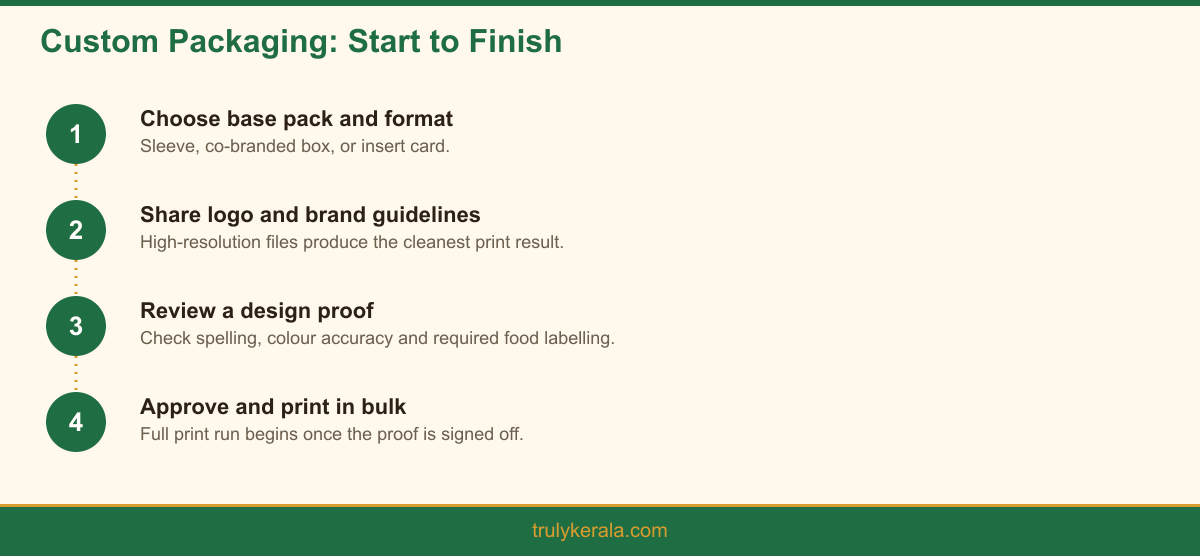
Infographic: the four-step process for ordering custom branded banana chips packaging.
A design proof is produced before the full print run, giving the business a chance to review exactly how the finished packaging will look. This step exists specifically to catch errors, a misspelled word, an inaccurate brand colour, before hundreds of units have already been printed.
Once the proof is approved, printing and packing begin at the confirmed order volume. This stage takes longer than a standard order dispatch, since it involves a dedicated print run rather than pulling from existing packaging stock.
Businesses working against a fixed event date should treat proof approval as the critical path step in the whole process. Every day spent deciding on a design change after the proof is issued is a day removed from the printing and packing timeline, so a designated approver who can turn around feedback quickly keeps the overall order on schedule.
Revisions to a proof are normal and expected, most businesses request at least one round of changes, typically around colour accuracy or logo sizing, before signing off. Building one revision round into the expected timeline avoids treating a normal correction cycle as an unexpected delay.
Minimum Order Quantities and Pricing
Custom packaging carries a minimum order quantity because print setup, plates, dies, or digital print run minimums, is a fixed cost regardless of how many units are produced. Below that minimum, the per-unit cost of customization becomes disproportionately high relative to the product itself.
Pricing is generally quoted as a combination of the base product cost and a per-unit customization premium, which decreases as order volume increases. A hundred-unit order sees a meaningfully better per-unit customization cost than a twenty-unit order, since the fixed setup cost is spread across more units.
Businesses requiring GST-compliant invoicing for a customized corporate order should confirm this at the enquiry stage, since procurement documentation needs can affect how the order is processed and invoiced compared to a standard retail purchase. Details on invoicing requirements are available via GST for businesses unfamiliar with the process.
Businesses comparing custom packaging costs against a generic branded merchandise item, a pen, a diary, a tote bag, often find the per-unit economics land in a similar range once presentation level is matched appropriately. The main difference is that a snack hamper gets consumed and appreciated immediately, while merchandise more often sits unused, which is the value trade businesses are actually making with this spend.
Design Tips and Common Mistakes to Avoid
The most common design mistake is submitting a low-resolution logo file, which prints visibly blurry or pixelated on packaging, especially on a sleeve where the logo is often enlarged beyond its original size. Always share the highest-resolution version of a logo available, ideally a vector file rather than a compressed image.
A second common issue is overlooking required food-packaging text, ingredient lists, FSSAI license details, and manufacturing information, when designing a fully custom box rather than a simple sleeve over existing packaging. A sleeve avoids this problem entirely since the required text remains visible on the pack underneath; a full custom box needs this information incorporated into the new design.
A third mistake worth flagging is leaving too little contrast between text and background colour on a printed sleeve, which can look fine on screen but becomes hard to read once printed and photographed under normal event lighting. Testing legibility at actual print size, not just on a laptop screen, avoids packaging that looks worse in person than expected.
Finally, businesses should avoid rushing the proof-review stage. It is far cheaper and faster to catch a spelling error or colour mismatch on a digital proof than after a few hundred units have already been printed and packed. Building a short review buffer into the timeline avoids this risk entirely.
A less obvious mistake is designing packaging in isolation from how it will actually be handed out. A sleeve that looks good as a flat digital mockup can print differently once wrapped around a curved pack, and a box designed without checking real-world stacking or shipping dimensions can end up costlier to ship than expected. Requesting a physical sample alongside the digital proof, where timeline allows, catches these issues before the full run.
Conclusion
Custom banana chips packaging changes presentation, not the product, and works best when format, branding and proof review are planned in order rather than rushed. Browse base pack options on the all products page, or contact TrulyKerala with your logo and target order volume to start a custom packaging quote.
Frequently Asked Questions
What is the minimum order quantity for custom packaging?

Can I customize the flavour or recipe, not just the packaging?
What file format should I submit my logo in?
How long does custom packaging take to produce?
Do custom boxes need ingredient and FSSAI information printed on them?
Can custom packaging include both banana chips and cardamom in one box?
Is a design proof shown before the full print run?
Can custom packaging be requested for a one-time event rather than an ongoing account?