Employee Welcome Kit Kerala: Onboarding with Local Snacks

HR and admin teams building an employee welcome kit increasingly move away from generic branded merchandise toward something new hires actually use on day one. This guide covers why local snacks outperform standard welcome-kit items, what to include, how to scale across a hiring pipeline, and how to time delivery around joining dates.
Key Takeaways
- A snack-based welcome kit gets used immediately, unlike merchandise that often sits unopened.
- A typical kit pairs a small banana chips pack with a note or company item.
- Standing order arrangements work best for companies with a steady hiring pipeline.
Why Local Snacks Work Better Than Generic Welcome Kit Merchandise
A first-day welcome kit competes for attention with a long list of onboarding tasks, laptop setup, paperwork, introductions. Merchandise, pens, notebooks, mugs, is functional but rarely memorable, and often ends up in a drawer rather than genuinely experienced by the new hire on their first day.
A snack, by contrast, gets consumed almost immediately. A small pack of banana chips placed on a new hire's desk is something they will actually open and try within the first hour, which is a rare kind of immediate engagement for any onboarding item.
For companies based in Kerala, or hiring employees relocating into the state, the snack also does double duty as an introduction to local food culture, something a generic branded item cannot offer regardless of design quality.
The underlying principle connects to broader employee recognition research: small, immediate, personal gestures tend to land better with new employees than larger but generic or delayed ones. A first-day snack is a small gesture, but its timing and immediacy carry more weight than its cost.
First impressions also shape how a new hire talks about their first day to friends and former colleagues, and a distinctive, regionally rooted welcome kit is simply more shareable than a standard-issue notebook. HR teams focused on employer brand as well as onboarding logistics increasingly treat the welcome kit as a small but visible signal of company culture.
There is also a cost argument that favours snacks over premium merchandise. A well-presented snack pack sits at a lower cost than most branded items of comparable perceived value, which matters for HR budgets covering welcome kits across a large or growing hiring volume.
What to Include in a Kerala-Themed Welcome Kit
A typical kit pairs a small banana chips pack, most often the 125g size, with a short welcome note and, where the company wants a fuller kit, a separate company-branded item such as a notebook or lanyard supplied by the employer directly.
Some companies extend the kit with a small pack of cardamom, particularly for employees who will be working alongside a Kerala-based team regularly and might appreciate a slightly more premium, locally rooted addition beyond the snack itself.
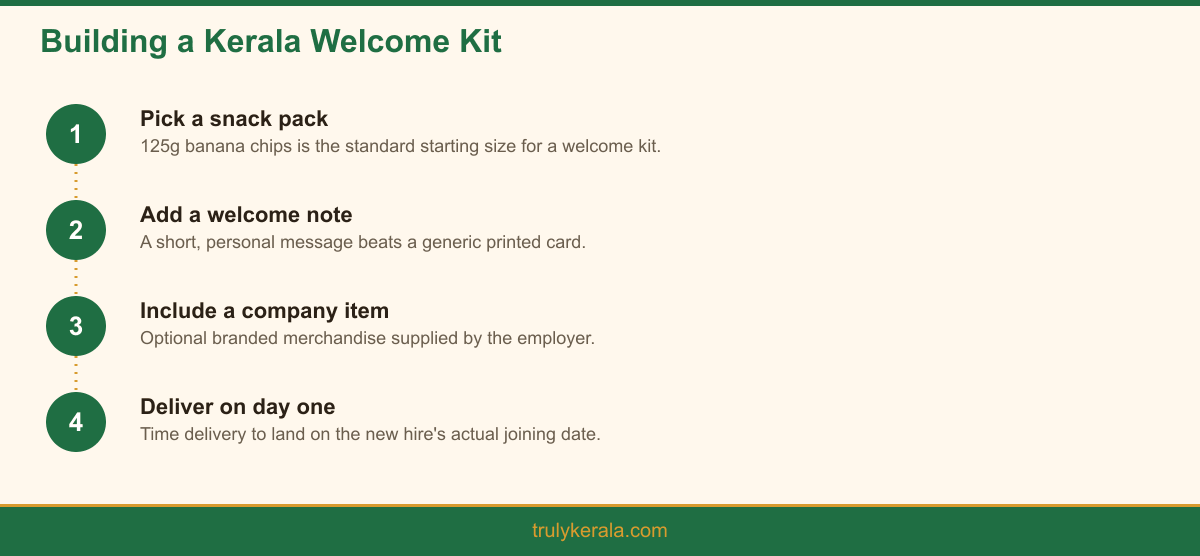
Infographic: a simple four-part framework for building a Kerala-themed employee welcome kit.
The welcome note matters more than its simplicity suggests. A short, specific message, even just the new hire's name and a line about the team they are joining, reads as considerably more thoughtful than a generic printed insert used across every kit regardless of recipient.
Companies with a stronger budget sometimes extend the kit further, a small desk plant, a company hoodie, a printed team photo, but the snack and note remain the core of the kit regardless of how much else is added. Everything beyond that core is an enhancement rather than a substitute for it.
Flavour choice for a welcome kit tends to favour the classic salted variant, since the goal is a broadly appealing first impression rather than catering to a specific spice preference the company has no way of knowing about a new hire in advance.
Scaling Welcome Kits Across a Hiring Pipeline
Companies hiring occasionally can treat each welcome kit as an individual request, ordered as new joining dates are confirmed. Companies hiring steadily, particularly IT and business-process employers in Kochi's Infopark and Smart City corridor, benefit more from a standing order arrangement rather than placing a fresh request for every new hire.
A standing arrangement typically works by confirming an expected monthly or quarterly hiring volume upfront, then having kits prepared and shipped as individual joining dates are confirmed, rather than negotiating pricing and lead time separately for every single new hire.
This approach mirrors how a HORECA account handles recurring supply: a rough expected volume set upfront, with actual delivery timing flexed around real demand as it happens, rather than every order treated as a brand-new, one-off request.
Companies scaling rapidly, adding dozens of new hires a month during a growth phase, benefit most from this arrangement, since it removes welcome-kit ordering from the list of individual tasks an HR coordinator needs to remember for every single new joiner and turns it into a background process instead.
For companies hiring across multiple office locations, a standing arrangement can also be split by location, so kits are dispatched to the correct office or home address automatically rather than routed through a single central point regardless of where the new hire is actually joining.
Ordering and Timing Around Joining Dates
Because a welcome kit needs to arrive by a specific joining date, HR teams should place the order with enough lead time to account for standard delivery, rather than treating it as a last-minute add-on to the onboarding checklist. A few business days ahead of the joining date is a reasonable standard buffer.
Batching orders around common joining dates, many companies start new hires on the first of the month or a fixed weekday, can simplify logistics further, since several kits can be prepared and dispatched together rather than as individually scheduled deliveries spread unpredictably across the month.
For remote hires or employees joining a Kerala-headquartered company without relocating, delivery can be sent directly to a home address rather than an office, extending the same welcome-kit concept to fully remote onboarding rather than limiting it to in-office new hires.
Confirming a delivery address early in the onboarding process, ideally as soon as an offer is accepted rather than waiting until the joining date is imminent, gives enough buffer for the kit to arrive on time even if the new hire's start date moves earlier than originally planned, which happens fairly often in fast-moving hiring processes.
Companies also use the same welcome-kit concept for relocation packages, employees transferring into a Kerala office from another city, where introducing the destination's food culture serves a similar purpose to a new-hire welcome, just for an internal transfer rather than an external new joiner.
HR teams juggling a busy onboarding checklist sometimes treat the welcome kit as a lower-priority task compared to laptop provisioning or system access, and it is worth resisting that instinct. Unlike IT setup, which a new hire expects regardless, a well-timed snack kit is one of the few onboarding touches that genuinely surprises and delights, and that effect depends entirely on it arriving on time.
Conclusion
A Kerala-themed welcome kit built around banana chips and cardamom gives new hires something they will actually use on day one, unlike most standard onboarding merchandise. Browse pack options on the all products page, or contact TrulyKerala to set up a one-time or standing welcome kit order for your hiring pipeline.
Frequently Asked Questions
What is typically included in an employee welcome kit?

Can companies set up a recurring welcome kit order for ongoing hiring?
How far ahead should a welcome kit be ordered before a joining date?
Can welcome kits be shipped to a remote employee's home address?
Are welcome kits only for companies based in Kerala?
Is cardamom included in a standard welcome kit?
Can welcome kits be combined with a broader corporate gifting order?
Do welcome kits need to be the same for every new hire?