Banana Chips Supplier for Hotels and Restaurants in Kochi

Hotels, restaurants and cafes looking for a reliable banana chips supplier in Kochi need a different kind of relationship than a one-time gifting order: recurring supply, consistent pricing, and a delivery schedule the kitchen can plan around. This guide covers how TrulyKerala works with hotels, restaurants and cafes (HORECA) accounts, from initial sampling through to a standing order.
Key Takeaways
- HORECA accounts differ from one-time orders because they are recurring rather than a single delivery.
- A trial order is the standard first step before committing to a monthly supply volume.
- Both banana chips and cardamom can be supplied on the same or separate recurring schedules.
What HORECA Supply Means for Banana Chips and Cardamom
The HORECA channel, hotels, restaurants and cafes, buys food products differently from an individual gifting or event customer. Instead of a single delivery for a fixed date, a HORECA account needs an ongoing supply relationship: the same product, arriving on a predictable schedule, at a price that does not need renegotiating every time.
For a property in Kochi, banana chips typically serve one of a few roles: a welcome snack at check-in, an in-room amenity, a breakfast buffet item, or a bar snack. Cardamom, by contrast, is usually a kitchen or beverage ingredient rather than a guest-facing item, used in chai, desserts, biryani and other dishes where the spice itself is part of the recipe rather than the presentation.
Because the two products serve different roles, a single property might order banana chips for guest service and cardamom for the kitchen on entirely different schedules and in different proportions, rather than treating them as a single combined order the way a gifting hamper would.
Both products are manufactured under TrulyKerala's FSSAI license, which is generally the first credential a hotel or restaurant procurement team checks before adding a new food supplier, since it confirms the product meets India's food safety registration requirements.
Consistency matters more in this channel than in a one-time gifting order. A hotel guest who receives a slightly different chip on their second stay barely notices, but a chef relying on the same cardamom for a signature dish every day needs the product to taste the same batch after batch. TrulyKerala's sourcing and processing is built around that kind of repeatability rather than one-off batch variation.
This is also why HORECA buyers tend to ask more detailed sourcing questions than a retail customer would, where the cardamom is grown, how the banana chips are fried, whether preservatives are used. Answering these clearly at the start of the relationship avoids repeated back-and-forth once the account is live and ordering regularly.
Packaging format is another detail HORECA buyers ask about that a retail customer rarely does. A kitchen decanting cardamom into its own storage containers cares less about retail pack aesthetics than a front-of-house team serving banana chips directly from the pack to a guest, where the packaging itself is part of what the guest sees.
Getting Started: Sampling and Onboarding as a Supply Account
Properties considering a new supplier relationship can request a smaller trial order before committing to a recurring volume. This is standard practice in HORECA purchasing generally, and TrulyKerala supports it: a trial batch lets the kitchen or F&B team assess quality and guest reception before signing on to a monthly commitment.
Onboarding as a recurring account typically involves confirming a few details upfront: expected monthly volume for each product, delivery address and receiving contact, invoicing requirements, and preferred delivery frequency. None of this needs to be finalized before the trial order, but having rough numbers ready speeds up the transition from trial to standing account.
Multi-property groups managing several hotels or restaurant locations under one procurement team can set up a single account covering multiple delivery addresses, rather than onboarding each property separately. This is worth flagging at the enquiry stage if it applies, since it changes how pricing and invoicing are structured compared to a single-location account.
Trial-order timing is worth planning around, rather than requesting a sample the week before an event or a menu launch. A trial batch gives the kitchen or F&B team a chance to test the product in an actual service setting, which takes at least a few days to properly evaluate before committing to a recurring order.
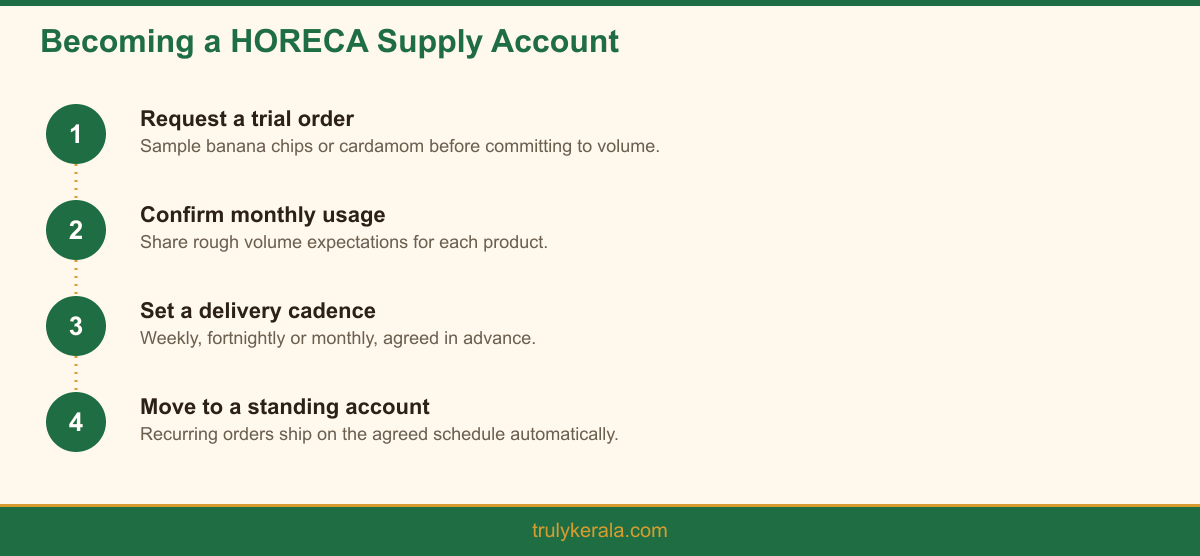
Infographic: how a hotel, restaurant or cafe moves from a trial order to a recurring HORECA supply account.
Recurring Orders, Pricing and Delivery Cadence
Wholesale pricing for HORECA accounts is generally quoted against expected monthly volume rather than a single order size, since the value of the relationship comes from its recurring nature rather than any one shipment. A kitchen using a modest, steady quantity of cardamom every month is a more predictable and often more valuable account than a single large one-off purchase.
Delivery cadence should be agreed explicitly rather than left informal. A restaurant kitchen cannot run out of an ingredient mid-service, so most HORECA accounts settle into a weekly, fortnightly or monthly delivery rhythm, timed against how quickly the property works through its stock, with a small buffer built in for unexpected demand spikes.
Properties that experience seasonal footfall swings, more guests during Kerala's tourist season or around major festivals, should flag this pattern early, since a fixed monthly volume that works for the off-season may fall short during peak months. Adjusting the recurring order ahead of a known seasonal spike is simpler than placing an urgent top-up order mid-season.
Invoicing for a recurring account is usually set up once at onboarding rather than negotiated for every delivery. Properties that need a consolidated monthly invoice covering multiple deliveries, rather than a separate invoice per shipment, should request that structure upfront, since it is simpler to set up correctly at the start than to change after several orders have already gone through.
Menu and Guest-Experience Ideas for Hotels, Restaurants and Cafes
Properties that name the product explicitly, on a menu, an amenity card, or a welcome-tray note, get more value from the regional-authenticity angle than those that serve it without context. A short line noting that the chips are Kerala-made and fried in coconut oil does more for guest perception than the snack sitting unlabelled in a bowl.
Cafes and restaurants using cardamom as a beverage ingredient, in filter coffee, chai or a signature dessert, sometimes highlight the spice's origin on the menu as well, particularly for guests unfamiliar with Kerala cuisine. This works especially well for properties positioning themselves around a regional or heritage dining concept rather than a generic multi-cuisine menu.
For businesses evaluating multiple potential suppliers before choosing one, TrulyKerala's existing local-guide content, including a broader look at where to source Kerala banana chips around the region, is available in the local buying guide, which is written for individual buyers but covers much of the same sourcing landscape a procurement team would evaluate.
Boutique and heritage properties in particular tend to get the most value from leaning into the regional story rather than treating banana chips as an interchangeable snack. A property already marketing itself around Kerala backwaters, houseboats or heritage architecture has a natural fit for a guest-facing snack that reinforces the same regional identity rather than a generic imported alternative.
Conclusion
A recurring HORECA supply relationship starts with a trial order and settles into a predictable delivery cadence once volume and pricing are confirmed. Review product options on the banana chips and cardamom pages, or contact TrulyKerala to set up a trial order for your property.
Frequently Asked Questions
Can I get a sample before committing to a recurring HORECA order?

What is the minimum monthly volume for a HORECA supply account?
Can banana chips and cardamom be ordered on different delivery schedules?
Does TrulyKerala supply cafes as well as hotels and restaurants?
Is TrulyKerala's product FSSAI licensed?
Can delivery volume be adjusted for seasonal demand changes?
Does TrulyKerala offer bulk cardamom pricing separate from banana chips?
How is HORECA pricing different from a one-time gift or event order?