Kerala Festival Gifting Beyond Onam: The Complete Guide

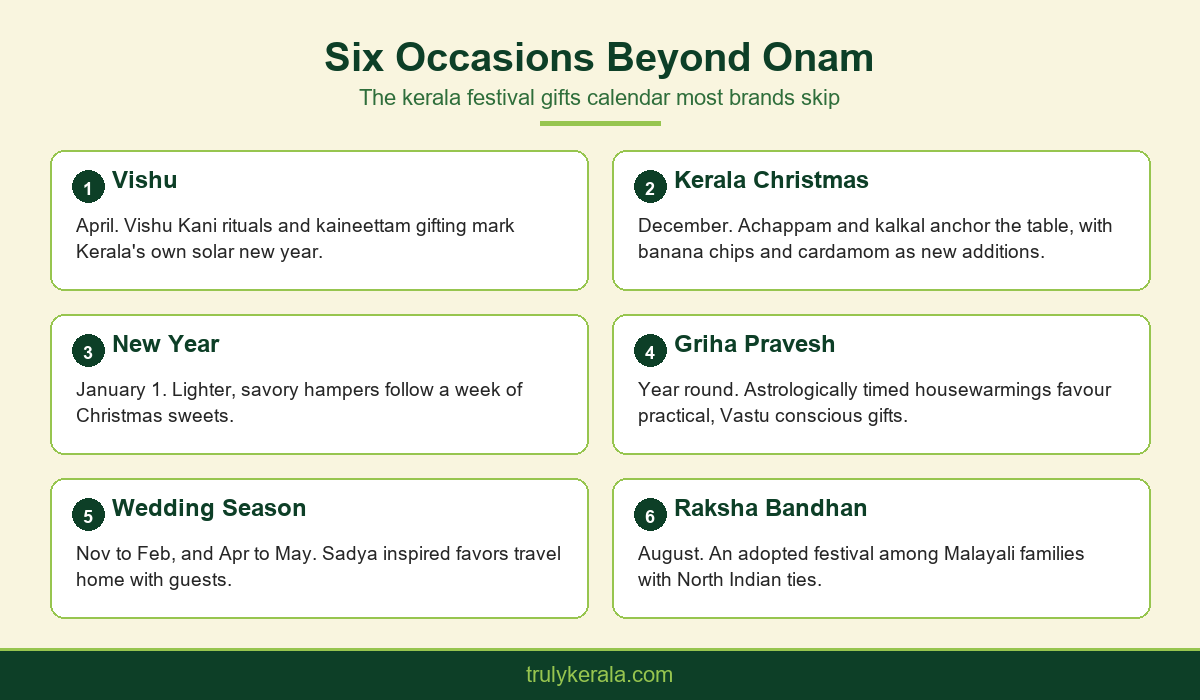
Ask most gifting brands about South Indian festivals and you will hear about Diwali, Pongal and Navratri, occasions built to travel across state lines. Kerala festival gifts rarely make that list, even though the state runs its own calendar of distinct, deeply held occasions beyond Onam. This guide maps that full calendar in detail, from Vishu in spring to wedding season, Christmas, New Year, housewarmings and Rakhi, and shows where Kerala's gifting culture has room that competitors focused on a generic pan South Indian list simply do not cover. Each occasion below links out to a full dedicated guide, so this page works as both an overview and a map to the rest of the coverage on this site.
Key Takeaways
Kerala festival gifts extend well beyond Onam to include Vishu, Kerala Christmas, New Year, wedding season, griha pravesh and Rakhi, each with its own gifting logic, timing and audience worth understanding separately.
Competitors running a pan South Indian festival calendar, built around Diwali, Pongal and Navratri, largely skip these Kerala specific occasions entirely, leaving an open gap for a brand willing to build for them.
Banana chips and cardamom work as a flexible backbone across all of these occasions, adjusted by format and packaging rather than reinvented each time, whether the recipient is a family member, a client or an employee.
Why Kerala Festival Gifting Needs a Wider Lens Than Onam
Onam earns its place as Kerala's biggest gifting occasion, and this site already covers it in depth through guides on traditional Onam gift hampers, the complete guide to Onam snacks and why banana chips anchor the Onam sadya. None of those occasions are repeated here. Instead, this pillar looks at everything else on Kerala's calendar that gifting content typically ignores.
That gap is not accidental. Building an Onam campaign is simple because it is one week, widely known, and easy to plan a single push around. Building coverage for Vishu, Christmas, New Year, weddings, housewarmings and Rakhi requires tracking six separate occasions with different timing, different rituals and different audiences, which is exactly why most brands do not bother.
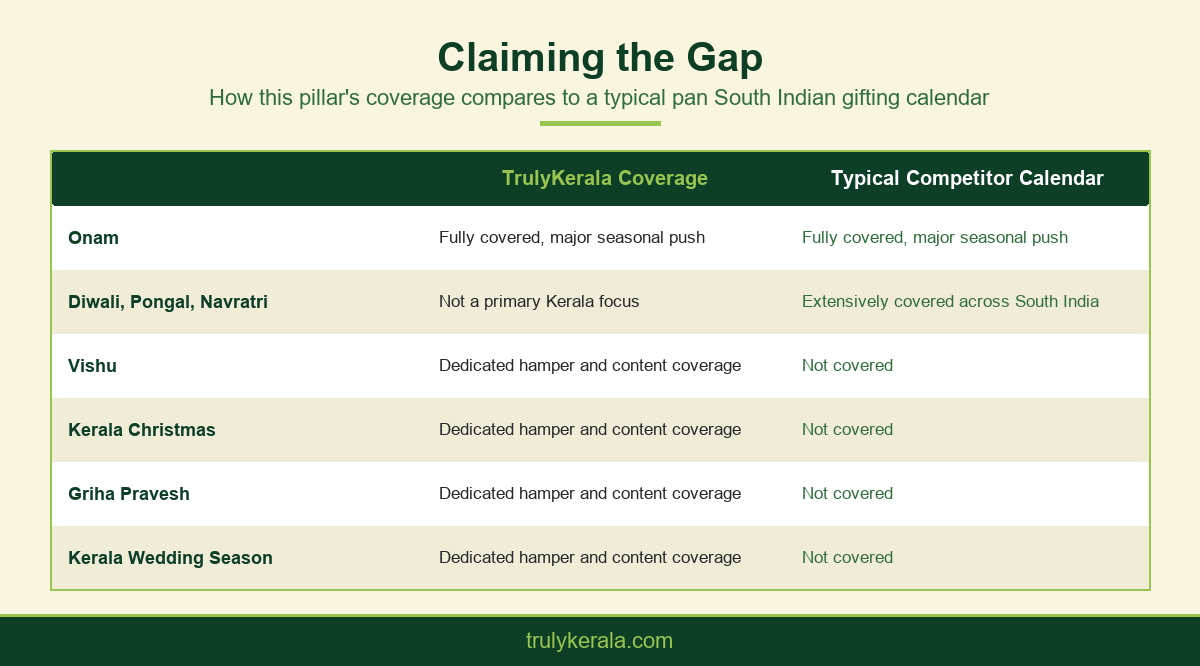
There is also a competitive reason to look past Onam. At least one large pan South Indian snack and sweet brand runs an extensive festival gifting calendar covering Diwali, Pongal, Ganesh Chaturthi, Krishna Janmashtami, Navratri and Sankranti, reaching customers across Tamil Nadu, Karnataka, Andhra Pradesh and beyond with a steady drumbeat of seasonal content and hampers. That calendar is thorough within its own scope, but it is built for a regional audience, not a Kerala specific one, and it does not extend into Vishu, Kerala Christmas, griha pravesh or Kerala's own wedding traditions at all. A brand that already owns Onam gifting has a natural next step available that a broader regional competitor is structurally unlikely to take, since doing so would mean building six additional, narrowly focused content and product tracks for one state alone, an investment that makes far more sense for a brand already rooted in Kerala than for one managing a portfolio spread across four or five states at once.
Where a Pan South Indian Calendar Stops Short
A typical festival gifting calendar built for South India covers Diwali, Pongal, Ganesh Chaturthi, Krishna Janmashtami, Navratri and Sankranti, occasions that either fall on shared national dates or are observed similarly across Tamil Nadu, Karnataka and Andhra Pradesh. This approach works well for reaching a broad South Indian audience with one content calendar, but it treats Kerala as interchangeable with its neighbours rather than distinct. It is efficient content strategy for reaching four states at once, but it leaves a Kerala shaped gap that nobody running that broader calendar has strong incentive to fill, since doing so would mean diluting a scalable regional strategy with content and products built for one state's specific occasions alone.
What Kerala Actually Celebrates on Its Own Terms
Vishu, Kerala Christmas and the state's specific wedding and housewarming customs do not appear on that generic list at all, despite being significant occasions for millions of Malayali households and businesses. Claiming this space means building content and hampers around what Kerala actually celebrates, not what a wider regional calendar assumes it celebrates. Each occasion covered in this pillar, Vishu, Kerala Christmas, New Year, griha pravesh, wedding season and Rakhi, gets its own dedicated guide linked in the sections below, rather than a single paragraph buried inside a generic festival roundup. Together these guides and this overview form one connected cluster, so a reader arriving through any single occasion can navigate to the rest without searching for each one separately.
Vishu: Kerala's Own New Year, Celebrated in Spring
Vishu falls in mid April and marks the Malayalam solar new year, built around the Vishu Kani ritual, a tray of rice, fruit, gold and a lit lamp arranged the night before so it is the first thing family members see on the morning of the festival. Kerala Tourism documents the ritual in detail, and the date itself is set using the Malayalam solar calendar rather than the lunar calendars behind many North Indian festivals.
Gifting around Vishu centres on the kaineettam, a small cash gift paired increasingly with a snack hamper of banana chips, sharkara varatti and cardamom. Because Vishu sits entirely outside a typical pan Indian festival calendar, brands that do build for it face far less competition than they would around Diwali or Pongal. Our dedicated Vishu gifting guide covers the full ritual, hamper ideas and timing in depth.
Corporate gifting programmes that already run an Onam push are well positioned to extend the same vendor relationship to Vishu with minimal extra setup, since the underlying products, banana chips and cardamom, do not change, only the hamper format and the messaging around it. For a workforce with a significant Malayali Hindu population, adding Vishu often costs little relative to what it signals about cultural awareness compared with sending the exact same generic spring greeting as every other vendor.
For Malayali families living outside Kerala, Vishu also tends to carry more weight than it would for someone still living in the state, since recreating the smell of coconut oil frying and the sight of a full Kani tray becomes harder the further someone is from home. A gift that arrives on the actual morning of Vishu, built around ingredients the recipient recognises immediately, often means more to this audience than a costlier but less specific alternative.
Kerala Christmas: A Tradition That Runs Deeper Than Cake
Kerala's Christian communities, concentrated heavily in central Kerala districts such as Ernakulam, Kottayam and Thrissur, celebrate Christmas with a food culture built around achappam, kalkal and rose cookies rather than the cakes and cookies more commonly marketed nationally every December. Wikipedia's overview of Christmas in India notes how sharply regional food traditions vary, and Kerala's Christmas table is one of the clearest examples.
Gifting here works best when it adds to this tradition rather than replacing it, pairing banana chips and cardamom alongside the achappam and kalkal that Kerala Christian households already make at home. Our Kerala Christmas snack hampers guide goes deeper into building a hamper that respects this existing table instead of competing with it.
Christmas gifting in Kerala also concentrates more narrowly by geography than Onam does, since Christian populations are heaviest in specific central Kerala districts rather than spread evenly across the state. A brand or business gifting into this audience benefits from understanding that narrower footprint, targeting effort where it will actually land, rather than applying an Onam scale campaign uniformly to a much smaller and more concentrated audience.
The timing of Kerala Christmas gifting also matters for logistics planning in a way Onam does not, since it lands in the same December window as national retail demand for cakes, decorations and courier capacity generally. Businesses that plan their Christmas orders early, ahead of the broader national rush rather than assuming Kerala specific suppliers face the same calm as the rest of the year, avoid the worst of the shipping delays that hit every courier network during this period.
New Year Gifting Right After Kerala's Busiest Season
New Year in Kerala arrives just a week after Christmas ends, which means most households and offices are already tired of sweet heavy gifting by January 1. This timing makes New Year a distinct gifting moment rather than an extension of Christmas, one that rewards lighter, more practical hampers over another round of chocolates and dry fruit boxes.
Banana chips and cardamom suit this moment well precisely because they read as a break from the preceding week's sweets, while still travelling and storing better than fresh alternatives during the busiest shipping period of the year. Our New Year gifting guide covers how to time and size these hampers for both family and corporate lists.
New Year also functions as a useful reset point for anyone auditing their broader kerala festival gifts programme. Since it falls right after the year's two biggest gifting pushes, Christmas and the run up to it, it is a natural moment to review what worked, retire formats that underperformed, and plan the rest of the year's occasions, from Vishu through Onam, while the previous season is still fresh enough to learn from.
New Year gifting also tends to reach the widest audience of any occasion covered in this pillar besides Onam, since it is observed regardless of religion or region across nearly every household and business in Kerala. That breadth makes it a useful anchor for brands still deciding which additional occasions, beyond Onam, to build into their own kerala festival gifts calendar first. Starting with New Year before layering in Vishu, Christmas or Rakhi lets a business test its hamper format and delivery process on a lower stakes, less emotionally loaded occasion before extending the same system to more culturally specific dates.
Griha Pravesh and Housewarming Gifting All Year Round
Unlike a festival with a shared calendar date, griha pravesh ceremonies are scheduled individually based on astrological calculations tied to the homeowner's birth chart, which means this occasion can fall in any month of the year. Griha Pravesh as a ritual is observed across India, though Kerala's version blends the religious ceremony with a long open house visit that most guests attend on the same morning. Because the date depends on astrology rather than a shared national calendar, griha pravesh gifting spreads evenly across the year instead of clustering into one predictable rush, which means a business or family supporting this occasion needs an always ready product rather than a seasonal one produced only around a specific festival window.
Because gifts are often displayed together and seen by a wide cross section of visitors, presentation and practicality both matter more here than at a private family occasion. Vastu conscious households in particular favour food gifts over decorative items, since consumables do not risk clashing with the home's chosen layout the way an ornament might. This makes griha pravesh one of the more forgiving occasions on this calendar for a snack based gift, since it avoids the usual risk of a food gift feeling less personal than a decorative one while also sidestepping the common problem of several guests bringing an identical showpiece. Our griha pravesh and housewarming gifting guide covers this occasion in full, including how to size a hamper to the scale of the ceremony.
Sizing a Housewarming Gift to the Occasion
A small, intimate griha pravesh calls for a more personal gift, while a large public housewarming with dozens of guests calls for something simpler and easier to produce consistently across many nearly identical gifts opened side by side. Matching effort to scale this way keeps the gifting programme sustainable even for a family or business handling several griha pravesh invitations across a single year. It also reduces the risk of every guest opening a visibly different gift on the same morning, which can unintentionally read as favouritism even when no ranking was ever intended.
Kerala Wedding Season: From the Sadya to the Favor Box
Kerala wedding season clusters heavily between November and February, with a second smaller window around April and May, and spans Hindu, Christian and Muslim communities each with their own feast traditions. The banana leaf sadya remains the emotional centre of most Hindu Kerala weddings, and Sadya as a food tradition has shaped how the state thinks about gifting well beyond the meal itself.
Kerala weddings also cluster into specific months rather than spreading evenly across the year, driven by a mix of astrological preference, weather and school holiday timing for extended family travel. This clustering means a family or business handling multiple weddings within a short window needs a supplier that can repeat a favor order reliably several times over a few months, not just fill a single one off request well.
Wedding favors that echo items already served on the sadya leaf, particularly banana chips, close the loop between the meal a guest just shared and the gift they carry home. Our Kerala wedding season gifting guide covers favors for guests, hosts and corporate sponsors involved in Kerala's wedding economy, and our existing coverage of banana chips as a wedding return gift adds further detail on ordering at scale.
Wedding gifting also crosses Kerala's religious communities more easily than most other categories. Christian and Muslim weddings in the state have their own distinct feasts, but banana chips and cardamom carry no strong religious association and are already familiar staples in Kerala kitchens regardless of faith, making them one of the few gift categories that works across a genuinely mixed guest list or client base without needing three separate strategies.
Rakhi and Raksha Bandhan Among Kerala's Adopted Occasions
Raksha Bandhan is not native to Kerala, but Malayali families with North Indian ties, interstate marriages or personal affection for the festival mark it every August. Raksha Bandhan as a broader Indian tradition centres on the bond between siblings, expressed through the tying of a protective thread and an exchange of gifts.
This smaller but real audience is easy for brands to overlook entirely, assuming Kerala has no stake in the festival. A Kerala rooted snack gift, distinct from the sweets and mithai that dominate Rakhi gifting nationally, gives these families a way to mark the day with something that feels specific rather than generic. Our Rakhi gifting guide covers this in more detail.
Rakhi is a useful example of why this pillar defines kerala festival gifts broadly rather than strictly as festivals native to the state. Families define their own gifting calendar based on what they actually celebrate, not what a regional classification says they should, and a gifting brand serving Kerala households needs to account for adopted occasions like Rakhi alongside native ones like Vishu and Onam. Treating Rakhi as part of the same calendar, rather than an unrelated national festival with no Kerala relevance, keeps the overall gifting strategy grounded in what households actually do rather than what a strict regional definition would predict.
Building One Gifting System Across the Whole Year
Treating these six occasions, plus Onam, as one connected system rather than six separate campaigns is where the real opportunity sits. A single supplier relationship built around banana chips and cardamom can carry a gifting programme from Vishu through wedding season, Christmas, New Year and Rakhi, adjusting format and packaging rather than sourcing something entirely new for each occasion. Our full year gifting roundup lays out every occasion covered in this pillar in one month by month view.
For businesses, this consistency also simplifies vendor management considerably. Our corporate bulk gifting programme, available as a dedicated product, supports recurring orders across whichever occasions a company chooses to build into its calendar, without renegotiating terms each time a new festival approaches.
The same logic applies to individuals managing gifting across a large extended family, where several of these occasions might land within the same few months. Rather than sourcing a new hamper concept for each one, choosing a consistent product base and varying the packaging, portion size and accompanying note keeps the effort manageable while still letting each specific gift feel considered for its occasion. Over time this also builds a recognisable identity for the giver, since recipients start to associate a particular product and presentation style with that specific family or business rather than treating each occasion as an unrelated purchase.
Where Product Quality Meets the Sourcing Story
Behind every hamper on this list sits the same two products, coconut oil fried banana chips and whole green cardamom, and the sourcing behind them matters as much as the occasion it is wrapped around. Our detailed look at cardamom origin, sourcing and quality grading explains what separates a well graded spice from a mass market one, a distinction worth knowing whether you are gifting for Vishu or Rakhi. Coconut oil frying and careful cardamom grading are not incidental details, they are the reason a recipient can tell the difference between a hamper built on genuine sourcing and one assembled purely to look good in a photograph. As Kerala festival gifts increasingly compete on presentation alone, sourcing quality becomes one of the few remaining ways a hamper can actually earn a repeat customer rather than a single seasonal purchase.
Conclusion
Kerala festival gifts stretch across a full year once Onam is no longer treated as the only occasion worth planning for. Vishu, Kerala Christmas, New Year, griha pravesh, wedding season and Rakhi each carry their own rituals, timing and audience, and together they represent a calendar that most pan South Indian gifting content simply does not cover. None of these occasions demand an entirely new product line or supplier relationship, since banana chips and cardamom already flex across every one of them with only small changes to format and packaging. Explore the dedicated guide for each occasion linked throughout this pillar, browse our full product range or banana chips category, and reach out through our contact page to build a gifting programme that covers Kerala's calendar properly, not just the one week everyone already knows about, and one that leaves real, addressable gaps for families and businesses ready to fill them properly.
Frequently Asked Questions
Where does cardamom sourcing fit into kerala snack gifts overall?

What are the main kerala festival gifts occasions beyond Onam?
Why do most gifting calendars skip Kerala specific festivals?
What is the best starting point for kerala gift hampers beyond Onam?
How does corporate gifting kerala businesses run differ from festival to festival?
Are banana chips and cardamom appropriate for all these occasions?
What is the single most important kerala festival gift ideas takeaway from this guide?
Does this guide cover Onam gifting in detail?
Is Vishu a bigger opportunity than Kerala Christmas for gifting?
Where can I see this entire calendar laid out month by month?