How to Send Kerala Snacks Abroad: The NRI Diaspora Guide

Every year, millions of Malayalis living outside Kerala face the same small but persistent problem: how do you keep a pantry stocked with real banana chips and cardamom when the nearest source is thousands of kilometres and several time zones away. Whether you are a student in Melbourne, an engineer in Dubai or a parent trying to mail a tin to a child in Toronto, the logistics of moving Kerala's most loved snacks across borders touch shipping, customs, online ordering, timing and gifting all at once. This guide pulls every piece of that puzzle into one place, with links to detailed breakdowns of each part.
Key Takeaways
- There are three realistic ways to get Kerala snacks abroad: international couriers, marketplace delivery where available, and ordering direct from the brand.
- Carrying sealed, packaged snacks through airport security and customs is far less restricted than most travellers assume, though destination rules and baggage weight still apply.
- The Gulf Malayali community, festival timing around Onam and Vishu, and thoughtful cross border gifting are three areas where a little planning makes an outsized difference.
Why This Guide Exists: The Diaspora's Snack Problem
Kerala has one of the largest and most globally dispersed diaspora populations of any Indian state, and food is consistently one of the strongest threads connecting that community back to home. Banana chips fried in coconut oil and whole green cardamom are not just snacks in this context, they are shorthand for an entire sensory memory of Kerala that is difficult to replicate anywhere else.
The practical challenge is that most grocery stores outside India, even ones that carry a reasonable Indian foods section, stock generic products rather than anything regional. A Malayali in London or a Malayali in Chicago is equally unlikely to find real Nendran plantain chips on a random supermarket shelf, which pushes almost every diaspora household toward one of a small number of alternative routes: asking a travelling relative to carry some, shipping a parcel, or ordering online, whether through a marketplace or directly from a Kerala based brand.
This guide is built around the idea that these routes are not mutually exclusive, and the right one often depends on your specific situation more than any universal best answer. A student ordering a single care package has different priorities from a family coordinating a bulk Onam hamper for a dozen relatives across three countries. Rather than pushing one solution, the sections below break the whole topic into the specific decisions a member of the diaspora actually has to make, in roughly the order they tend to come up.
A Global Community With One Shared Craving
From the Gulf to North America, Europe, Australia and Southeast Asia, the specific details of diaspora life vary enormously, but the craving for authentic Kerala snacks shows up almost everywhere Malayalis have settled in meaningful numbers. Community associations, informal friend networks and even workplace groups often end up functioning as informal supply chains for these snacks long before any formal shipping option existed.
This global spread is precisely why a single, comprehensive resource is more useful than a scattering of generic shipping tips. Someone in Toronto and someone in Doha are solving a version of the same problem, but the specific courier, customs and timeline details differ enough that a one size fits all answer rarely holds up in practice.
What Makes Kerala Snacks Different From Generic Indian Snacks
The distinction that matters most to Malayali households is not that these are Indian snacks broadly, but that they are made a specific way. Coconut oil rather than vegetable oil, the Nendran plantain variety rather than a generic banana, and traditional preparation methods all shape a flavour and texture profile that is instantly recognisable to anyone who grew up with it, and just as instantly noticeable when it is missing.
This is also why substitution rarely satisfies the craving. A generic banana chip made with a different oil or a different plantain variety technically fills the same snack category, but it does not deliver the same experience, which is exactly why demand for the authentic version persists even in cities with a reasonably well stocked Indian grocery scene.
Shipping Kerala Snacks Abroad: Your Real Options
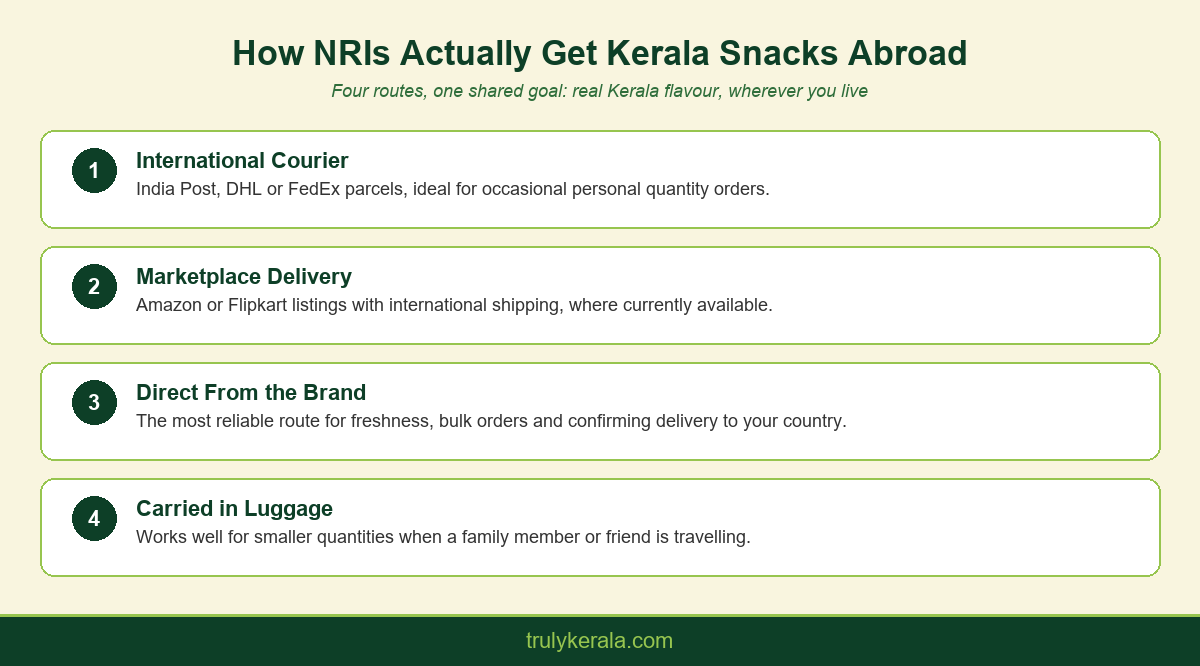
Once a household decides to move beyond relying on travelling relatives, the options split into three broad categories: international courier services, marketplace listings that support cross border delivery, and direct orders placed with the brand itself. Each has different strengths depending on whether you need a one off small quantity or a larger, recurring supply.
International couriers such as India Post's international parcel service, DHL and FedEx are well suited to personal quantity orders and are already familiar to most families who have shipped pickles, spice mixes or sweets abroad before. Marketplace delivery is convenient when it is available, but coverage for regional food brands is inconsistent and changes over time. Direct enquiries with the brand tend to be the most reliable route for anything beyond a small, occasional order, particularly when bulk quantities or specific packaging needs are involved. Our detailed shipping guide for NRIs walks through all three in depth, including realistic costs and timelines by region.
Freshness and packaging deserve just as much attention as the choice of courier. Chips fried in coconut oil and cooled properly before sealing hold their crunch for weeks, while poor sealing or crushed tins can undo even the best courier's timeline. Cost is also worth planning around in advance, since shipping is generally priced on whichever is higher between actual and volumetric weight, and rates differ substantially between nearby regions like the Gulf and long haul destinations such as North America or Australia. Building in a buffer of two to three weeks before any specific date you are shipping for, whether a birthday or a festival, absorbs most of the unpredictability that comes with customs processing at the destination end.
Carrying Snacks vs Shipping: Customs and Travel Rules
For travellers who would rather carry snacks personally than arrange a shipment, the good news is that sealed, commercially packaged snacks like banana chips face very few restrictions at Indian airport security or under India's baggage rules. The more relevant consideration is simply your checked baggage weight allowance, since a few extra tins add negligible weight but several kilograms can start affecting excess baggage charges.
The destination side of the journey matters just as much. Most countries reserve their strictest food import rules for fresh produce, meat and dairy, treating dry, shelf stable, commercially packaged snacks far more leniently. Our full breakdown of customs and travel rules covers exactly what to expect at security, what to declare at customs, and when carrying stops making sense compared to shipping a larger quantity instead.
A simple rule of thumb works for most travellers: keep snacks in their original, labelled commercial packaging, declare food items honestly if a destination customs form asks, and treat your checked baggage weight allowance as the real constraint rather than worrying about the snack itself being restricted. Members of the global NRI community who travel this route regularly tend to describe it as far less complicated in practice than it sounds on paper, once the original packaging and honest declaration habits are in place.
Where to Buy: Amazon, Flipkart or Direct From the Brand
Choosing where to place the order matters as much as choosing how it gets shipped. Marketplaces offer familiarity and, within India, often faster domestic delivery. Ordering direct from a brand's own website typically means fresher stock, a wider product range, and a much easier path to asking specific questions about international delivery to your country.
Neither option is universally correct, and the right answer usually comes down to what you are optimising for on a given order. A relative in India picking up a quick birthday gift benefits from a marketplace's speed and familiarity. An NRI trying to arrange a shipment to a new address abroad, or a family placing a larger bulk order, tends to get more value from going direct, both for the freshness benefit and the ability to ask specific questions before committing to an order.
Why Freshness Tips the Scale Toward Direct Orders
A product that ships directly from the brand's packing line generally reaches the customer faster than one that first sits in a third party marketplace warehouse. For something like banana chips, where crunch and flavour depend heavily on how recently the batch was fried and sealed, this difference is noticeable the moment the tin is opened, which is one reason NRIs shipping internationally increasingly default to ordering direct.
When a Marketplace Still Makes Sense
Marketplaces remain a strong choice for smaller, domestic gifts within India, where speed and a familiar checkout matter more than squeezing out the last bit of freshness. Our detailed comparison of marketplace and direct ordering breaks down exactly when each option wins, including the specific case of ordering products to be shipped internationally.
Care Packages for Students and Professionals Abroad
Students and young professionals settling into a new country are some of the most frequent recipients of care packages from home, and getting the contents and timing right makes a real emotional difference. A good package balances shelf stable snacks, a small personal touch, and something practical, timed around exams, deadlines or a first festival away from Kerala rather than sent at a random moment.
Packaging quality matters just as much as the contents themselves, since a care package that arrives crushed or stale undoes much of the intended effect. Our complete care package guide covers exactly what to include, how to pack it for a long journey, and how to time delivery around the moments that matter most to someone adjusting to life abroad.
It is worth treating a care package as an ongoing habit rather than a single gesture tied to a big move abroad. The adjustment period for most students and early career professionals runs a full year or longer, and a second or third package sent quietly partway through that stretch, without a specific occasion attached, often means just as much as the first one did when everything was still new and unfamiliar.
The Gulf Malayali Community: A Special Case
No diaspora hub has a closer, more constant relationship with Kerala than the Gulf, home to one of the largest concentrations of Malayalis outside India. Frequent flights, decades of family ties, and community networks that formed generations ago mean expats across the UAE, Saudi Arabia, Qatar, Oman, Bahrain and Kuwait are unusually well informed about what authentic Kerala food should taste like, and unusually quick to notice when a product falls short.
This combination of proximity and high standards makes the Gulf one of the more interesting diaspora markets to understand. Shorter shipping distances and generally accommodating import handling for sealed snacks also make it one of the more straightforward regions to serve. Our deeper look at Gulf Malayali food habits explains why authenticity carries so much weight in this specific community and what that means for anyone ordering snacks to Dubai, Abu Dhabi or elsewhere in the region.
It also helps to understand just how large this population is. A substantial share of Indians living in the UAE trace their roots back to Kerala specifically, and similar patterns hold across Saudi Arabia, Qatar, Oman, Bahrain and Kuwait. That scale is exactly why community coordinated bulk orders, shared shipments and word of mouth recommendations move so quickly through Gulf Malayali networks compared to more scattered diaspora hubs elsewhere in the world.
Celebrating Onam, Vishu and Festivals Away From Home
Onam and Vishu do not pause for a household that has moved abroad, but they do change shape considerably. Without a home garden for a pookalam or a large joint family kitchen for a full sadya, diaspora families lean heavily on traditional snacks and a scaled down version of the feast to keep the occasion feeling distinct from an ordinary day.
Timing is the biggest practical challenge, since both festivals follow the Malayalam calendar rather than the Gregorian calendar most households otherwise use. Our guide to celebrating Onam and Vishu as part of the diaspora covers how families recreate the sadya, keep the Vishu Kani ritual intact, and plan ahead so festival snacks arrive on time. For readers specifically looking for Onam gift hamper ideas, our existing Onam hamper guide is also worth a look, and for Vishu specifically, our dedicated Vishu Kani gifting guide covers hamper ideas built around that occasion.
Beyond the two headline festivals, the same planning principle applies to any Kerala occasion celebrated abroad, from a wedding anniversary to a housewarming. Ordering snacks and hamper ingredients well ahead of the date, rather than scrambling once the occasion is already close, is consistently the difference between a celebration that feels complete and one that feels like an afterthought squeezed in around a busy week.
Gifting: Sending Something Back or Sending Something Over
Gift giving across the diaspora runs in both directions. NRIs abroad want care packages and snacks from home, while family still in Kerala appreciates a thoughtful gift sent from abroad just as much, even if the specific items differ. In both directions, food gifts consistently outperform generic alternatives because they are personal, shelf stable, and rarely duplicated by someone else's gift for the same occasion.
A curated hamper built around two or three complementary items, timed to arrive before a real occasion rather than whenever convenient, tends to leave the strongest impression. Our full gift guide for family across the diaspora covers ideas for both directions, along with practical tips on presentation and timing that apply whether the gift is travelling to Kerala or away from it.
A short personal note explaining why a specific item was chosen adds a disproportionate amount of value for very little extra effort, and it is one of the simplest ways to turn a functional order into something that reads as a genuine gift. This applies equally whether the recipient is a parent in Kochi or a cousin newly settled in a country they are still getting used to.
Putting It All Together: A Simple Decision Framework
With so many moving parts, whittling all of this down to a simple starting question helps. Ask yourself three things before placing an order: how much do you need, how soon do you need it, and is it travelling to or from Kerala. The answers point you toward a specific route far faster than trying to weigh every option from scratch each time.
For a small, occasional quantity travelling with a person rather than a parcel, carrying remains the simplest option, provided you keep everything in its original commercial packaging. For a recurring supply or a larger one time order, shipping through a courier or ordering direct from the brand almost always beats trying to coordinate around someone's travel schedule. For anything time sensitive, such as a birthday, a festival or an exam, working backwards from the date and building in a two to three week buffer removes most of the stress that otherwise comes from ordering at the last minute.
Direction matters too. Snacks and cardamom moving from Kerala to an NRI abroad are the most common flow and the best served by the shipping and care package guidance in this article. Gifts moving the other way, from an NRI back to family in Kerala, tend to work best as a curated hamper of something the recipient would not typically buy for themselves, timed to a specific date rather than sent as a routine gesture.
None of this needs to be complicated to work well. The households that stay most consistently connected through food are rarely the ones making one elaborate, once a year gesture. They are the ones who build a simple, repeatable habit around ordering, whether that is a quarterly restock for a Gulf pantry, a care package sent every semester, or a gift hamper that arrives like clockwork before every major festival.
Beyond Logistics: Why This Matters to the Diaspora
It is worth stepping back from the logistics for a moment to note why this entire topic carries the weight it does. Food is one of the fastest, most reliable ways to feel connected to a place you no longer live in day to day, and for many in the Malayali diaspora, a specific brand of banana chips or a particular grade of cardamom is tied to childhood memories that no amount of local substitution can fully replace.
If you have not yet read the more personal side of this story, the nostalgia and heritage behind Kerala's banana chips is a companion piece worth reading alongside this practical guide. Where that piece explores why these snacks mean so much to people who grew up with them, this guide is meant to be the step by step reference for actually getting them into your hands, wherever in the world you happen to be living now.
There is also a quieter, longer term benefit to getting this right. Children raised abroad often form their entire understanding of Kerala food through whatever their parents choose to keep stocked at home, since they do not have the same lived memory of growing up in Kerala itself to draw on. For that generation, an authentic snack is not nostalgia, it is simply the baseline they grow up expecting, which makes the sourcing decisions diaspora parents make today part of how Kerala food culture gets passed on to a generation that may only visit the state occasionally.
Conclusion
Getting authentic Kerala banana chips and cardamom to wherever you live now is no longer a matter of luck or waiting for a travelling relative. Between couriers, marketplaces, direct ordering and a little planning around customs and festival timing, every part of this journey has a reliable solution. Explore the detailed guides linked throughout this page for the specific part of the process you are working through, or reach out to the TrulyKerala team directly if you have a question about shipping to your country. Whenever you are ready to order, TrulyKerala's full range of banana chips and cardamom is available to bring a real taste of Kerala to your table, wherever that table happens to be.
Frequently Asked Questions
What is the easiest way for NRIs to get Kerala snacks abroad?

Can I carry banana chips through airport security without issues?
Is it legal to ship Indian snacks to another country?
How do I know if a Kerala food brand ships internationally?
What is the difference between Gulf and Western diaspora demand for Kerala snacks?
How far ahead should I order snacks for a festival like Onam?
Are banana chips a good gift for someone living abroad?