Buy Cardamom in Bulk: A Business Buyer's Guide

Restaurants, cafes, caterers and retailers looking to buy cardamom in bulk need to understand grading, pricing and storage before placing a large order. This guide covers what determines cardamom grade and price, how minimum order size works, and how to store stock properly once it arrives.
Key Takeaways
- Cardamom is graded primarily by pod size, and price varies noticeably between grades.
- Wholesale pricing is quoted per kilogram against confirmed grade and volume.
- Proper storage preserves aroma and flavour far longer than cardamom left in unsealed packaging.
Understanding Cardamom Grades and What They Mean for Bulk Buyers
Whole green cardamom is graded primarily by pod size, commonly described using terms like bold, medium and small. Larger, more visually uniform pods command a higher price, since they are prioritized for gifting and retail presentation, where appearance matters alongside flavour.
For a business buying purely for flavour extraction, a restaurant kitchen, a chai stall, a bakery, pod size has little bearing on the finished dish. A smaller grade delivers the same aromatic oils as a larger one, since the flavour compound lives inside the pod regardless of its external size or uniformity.
Grading and quality tracking for Indian cardamom is overseen through the systems maintained by the Spices Board of India, which sets the reference standards the wider trade, including TrulyKerala's own sourcing, works against.
Businesses new to bulk spice buying sometimes assume the highest grade is always the right choice. In practice, matching grade to actual use case, premium bold pods for a gifting hamper, a smaller grade for kitchen use, is the more cost-effective approach for most recurring business buyers.
Colour and moisture content also factor into quality assessment alongside pure size grading. A well-processed pod holds a consistent green colour and a slightly firm texture; pods that look faded or feel unusually dry have typically lost some of their aromatic oil content, regardless of what size grade they were originally sorted into.
Buyers unfamiliar with cardamom grading terminology should not hesitate to ask a supplier directly what grade a given batch falls under and why, rather than relying on price alone as a proxy for quality. A transparent supplier should be able to explain the grading behind any quote without difficulty.
Aroma is ultimately the most reliable quality check available to a buyer without lab equipment. Fresh, well-stored cardamom releases a strong scent as soon as a pod is lightly crushed between fingers; pods that smell faint or musty, regardless of their size grade, are usually past their prime and worth flagging with the supplier before a bulk order is confirmed.
Wholesale Pricing and How It's Calculated
Wholesale cardamom pricing is quoted per kilogram once grade and volume are confirmed, rather than as a fixed retail-style price per pack. Because cardamom pricing is more volatile than banana chips, tracking closer to commodity spice markets, quotes reflect current sourcing costs rather than a static published rate.
Volume affects price the same way it does for most bulk food products: larger confirmed orders generally see a better per-kilogram rate than small ones, since sourcing and packing costs are spread across more product. Businesses with a predictable recurring need benefit most from locking in a consistent order size rather than buying irregularly.
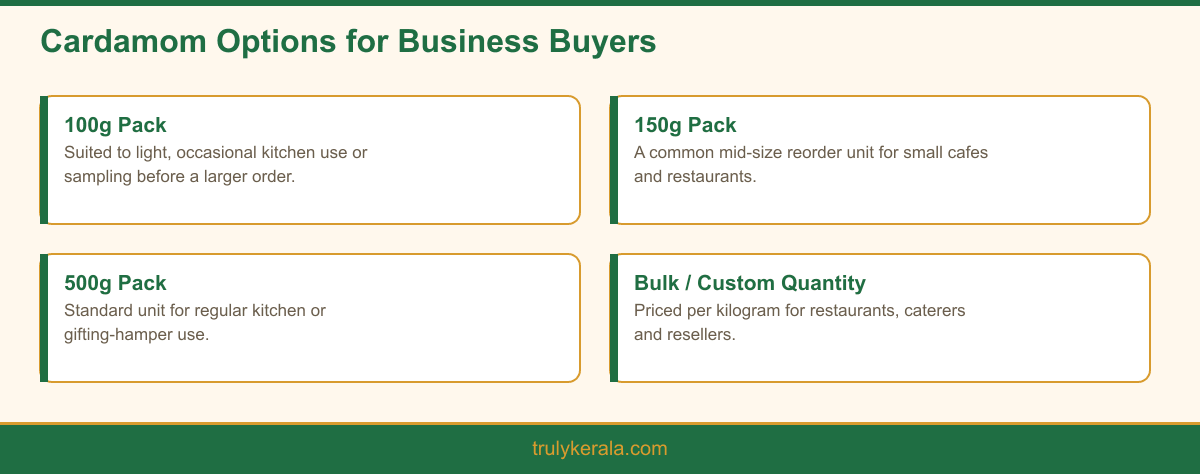
Infographic: cardamom pack size options from single retail packs through to bulk business orders.
Direct sourcing matters more here than for most food products, since going through fewer intermediate traders generally protects a business from the sharpest price swings compared to buying through a longer supply chain. TrulyKerala sources cardamom directly rather than through resellers, which is worth confirming with any supplier before committing to a recurring account.
Seasonal harvest timing also affects pricing, since cardamom is an agricultural crop with defined harvest windows rather than a manufactured product available at constant supply year-round. Buyers planning a large order around a known low-supply period should expect less price flexibility than during a period closer to fresh harvest, when supply is more plentiful.
Businesses that lock in a recurring monthly order, rather than buying opportunistically whenever price looks favourable, generally get more predictable budgeting even if the per-kilogram rate occasionally sits slightly above a short-term market low, since the tradeoff is consistent supply and simpler planning rather than chasing the cheapest possible spot price.
Minimum Order Size and How to Place a Bulk Order
There is no fixed minimum for a bulk cardamom order, though very small quantities may not see meaningful savings over standard retail pack pricing. Most business buyers start seeing a worthwhile bulk rate once they move beyond the 500g pack size into kilogram-level quantities.
Placing an order starts with sharing intended use, kitchen ingredient, gifting, resale, alongside expected grade preference and quantity. From there, TrulyKerala can confirm current pricing and expected delivery timeline, which is generally shorter outside peak festival demand periods.
Restaurants and cafes setting up a recurring account rather than a one-time bulk purchase should review the dedicated HORECA supply guide, which covers how a standing delivery schedule is set up alongside cardamom or banana chips, or both together.
Retailers and resellers buying cardamom to stock their own shelves, rather than to use as a kitchen ingredient, should also flag this at enquiry stage, since resale pricing and packaging requirements can differ from a kitchen-use order where the cardamom is repackaged into the business's own storage rather than displayed for sale as-is.
First-time bulk buyers sometimes benefit from starting with a mid-size trial quantity before committing to a full recurring volume, similar to how a HORECA account typically begins with a sample order. This lets a kitchen or retailer confirm the grade and quality meet expectations before locking in a larger standing commitment.
Storage and Shelf Life for Businesses Holding Stock
Whole green cardamom holds its aroma considerably longer than ground cardamom, which is one reason businesses buying in bulk should generally prefer whole pods over pre-ground powder unless the recipe specifically calls for it. Grinding releases the aromatic oils faster, which then degrade faster once exposed to air.
Correct storage means an airtight container, kept away from direct light and heat, ideally in a cool, dry area of the kitchen or storeroom rather than near a stove or oven where ambient heat is higher. Cardamom left in an opened bag or a loosely sealed container loses potency noticeably faster than properly sealed stock.
Businesses holding several weeks or months of stock should rotate older batches to the front of use, standard first-in-first-out practice, rather than letting the most recently delivered batch get used first while older stock sits untouched and slowly loses aroma in storage.
For businesses buying at true bulk scale, several kilograms or more, splitting stock into smaller sealed containers for daily kitchen use, while keeping the bulk of the order in a single larger sealed container, reduces how often the main stock is exposed to air. Repeated opening and closing of one large container is one of the more common ways bulk-bought cardamom loses potency faster than expected.
Businesses in humid coastal areas, much of Kerala included, should pay particular attention to moisture control during storage, since cardamom pods absorb ambient humidity more readily than many other dried spices. A tightly sealed container with a small food-safe desiccant packet is a simple, low-cost way to protect a larger bulk order through the monsoon months.
Conclusion
Buying cardamom in bulk comes down to matching grade to actual use, understanding how volume affects pricing, and storing stock correctly once it arrives. Browse pack options on the cardamom page, or contact TrulyKerala with your expected volume and use case to get a wholesale quote.
Frequently Asked Questions
What is the difference between cardamom grades?

Is there a minimum order quantity for bulk cardamom?
Should restaurants buy whole or ground cardamom in bulk?
How should bulk cardamom be stored?
Does cardamom pricing change with the market?
Can I buy both banana chips and cardamom on the same bulk order?
Is TrulyKerala's cardamom sourced directly from growers?
Can a cafe set up a recurring monthly cardamom order?