Corporate Gift Hampers: Kerala Banana Chips and Cardamom

Businesses building corporate gift hampers for clients or staff increasingly reach for regional food over generic merchandise. This guide covers what typically goes into a TrulyKerala hamper, how sizing and price tiers work, timing around festive seasons, and how to place and customize an office gifting order.
Key Takeaways
- A standard hamper pairs banana chips in two or three flavours with a pack of whole green cardamom.
- Price tiers scale with pack size and presentation level, not just raw product cost.
- Diwali, Onam and year-end are the three peak ordering windows for corporate hampers.
What Goes Into a Corporate Gift Hamper
A typical TrulyKerala corporate hamper combines two or three flavours of banana chips with a pack of whole green cardamom, wrapped or boxed together. The mix works because it pairs a savoury, immediately consumable snack with a smaller, higher-value spice item that keeps considerably longer, giving the hamper both instant appeal and a bit of lasting value.
Flavour selection usually leans toward a safe, broadly likeable combination for a mixed office or client list, classic salted alongside one or two spiced variants, rather than an all-spicy or all-sweet mix that risks not suiting every recipient. Businesses with a specific audience in mind, an all-vegetarian client base, for instance, can request a flavour mix tailored to that group.
Presentation is the other half of the hamper. Options range from a simple wrapped pack with a ribbon to a fully boxed hamper with a printed insert card carrying the sender's message. The choice affects both cost and perceived value, and businesses should decide on a presentation level before requesting a price quote, since it changes the per-unit price meaningfully.
The underlying idea behind food-based corporate gift giving is straightforward: a gift that gets used immediately leaves a stronger impression than one that gets set aside. Office gifting in particular competes for attention with dozens of other vendor and client gifts arriving in the same festive week, and a snack hamper tends to get opened and shared around a desk far faster than a branded pen or diary does.
Businesses new to sourcing regional food gifts sometimes worry about dietary restrictions across a large recipient list. Banana chips and cardamom are both vegetarian, contain no alcohol, and carry no common allergens beyond coconut, which makes the combination workable across most corporate audiences without needing a separate dietary-restricted version of the hamper.
A short accompanying note explaining what the recipient is receiving, that the chips are fried in coconut oil rather than a generic vegetable oil, or that the cardamom is sourced directly from Kerala growers, adds context that a silent hamper does not communicate on its own. Businesses that include even a brief line of this kind on the insert card tend to see the story land better with recipients unfamiliar with the brand.
Hamper Sizes and Price Tiers for Different Occasions
Hamper size generally follows the occasion. A lighter touch, built around the 125g or 150g pack sizes, suits a large staff-wide distribution where the goal is reach rather than per-recipient value. A heavier hamper, built around the 500g pack alongside a larger cardamom pack, suits a smaller list of top clients or leadership-level gifting where per-unit value matters more than volume.
Price tiers are quoted per finished hamper once quantity and presentation level are confirmed, rather than as a flat multiplier of retail pricing, since packaging and assembly add cost that scales differently than the product itself. Larger orders generally see a better per-unit rate than smaller ones, but the gap is less dramatic for hampers than for loose bulk product, because assembly labour does not shrink much with volume the way raw product cost does.
Businesses working with a fixed per-recipient budget should share that figure upfront rather than starting from a product list, since TrulyKerala can usually recommend a composition that fits a target price point more efficiently than the reverse process of pricing out a wishlist and adjusting down.
It is worth separating two pricing questions that are easy to conflate: cost per hamper and total order cost. A business comparing a 200-unit staff hamper against a 20-unit leadership hamper should expect the per-unit cost to move in opposite directions, staff hampers get cheaper per unit at volume, while a small premium leadership run carries a higher per-unit cost precisely because it is not benefiting from volume pricing.
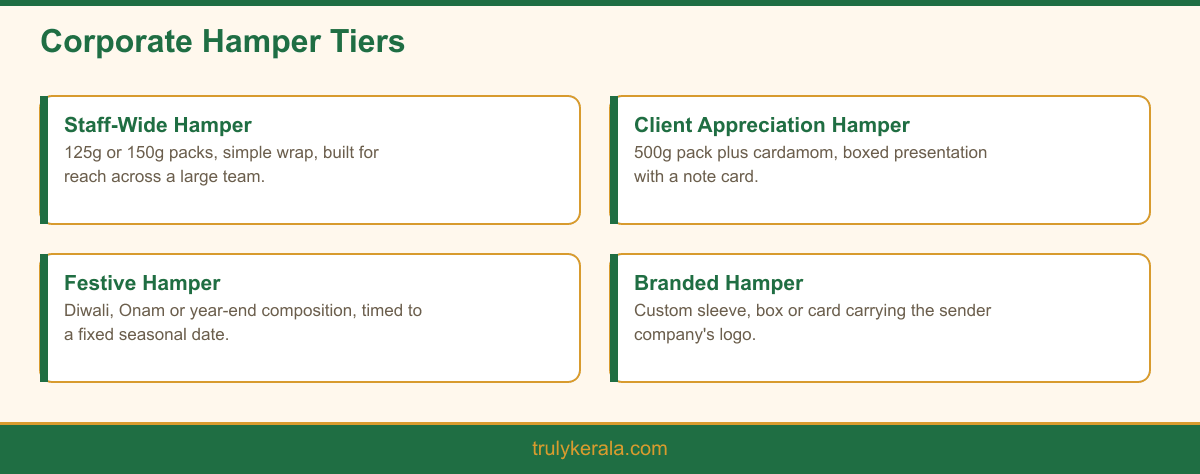
Infographic: four common corporate gift hamper tiers for Kerala banana chips and cardamom orders.
Festive-Season Hampers: Diwali, Onam and Year-End Gifting
Corporate gifting has three predictable peak windows: Diwali, Onam, and the year-end holiday season. Diwali corporate hampers in particular are a well-established category across India generally, and Kerala-origin snacks stand out precisely because they are less common in the standard Diwali dry-fruit-and-sweets rotation most businesses default to.
Onam sits closer to TrulyKerala's core identity, and the brand already covers Onam-specific hamper composition and traditional gifting context in a dedicated Onam gift hamper guide. The corporate angle covered here is about applying that same seasonal demand to a business gifting list rather than an individual family purchase.
Year-end hampers, sent around the calendar new year rather than a specific festival, tend to be less time-pressured than Diwali or Onam, since there is no fixed religious or cultural date attached. Businesses that missed the Diwali or Onam window sometimes shift a client-gifting budget to year-end instead, treating it as a lower-pressure fallback opportunity.
Beyond these three major windows, some businesses also order smaller hamper runs around company anniversaries, product launches, or a locally significant event tied to their own calendar rather than a national festival. These off-cycle orders are handled the same way as any other hamper request, but tend to move faster through production since they are not competing with the seasonal surge in demand around Diwali and Onam.
Ordering, Customization and Delivery for Office Gifting
Placing a hamper order starts with recipient count, occasion, and rough budget per hamper. From there, TrulyKerala proposes a composition and presentation level, and confirms a delivery schedule that works backward from the target gifting date, since packing and assembly for a large hamper run takes longer than a standard retail dispatch.
Businesses wanting their own branding on the hamper, a printed sleeve, a co-branded box, or a company-specific card, should review the dedicated custom packaging guide, since branded hampers involve a print setup step that adds to the standard hamper lead time.
Delivery for staff-wide hampers is usually handled as a single bulk shipment to the office address, split internally by the HR or admin team, rather than TrulyKerala shipping to each individual employee. Client hampers, by contrast, are more often shipped directly to each recipient's address, which changes how the delivery logistics and address list need to be prepared before the order is confirmed.
Businesses running a direct-to-client shipment should prepare a clean address list with recipient names, delivery addresses and phone numbers before confirming the order, since correcting incomplete address data after packing has begun slows down the whole batch rather than just the affected recipients. A single spreadsheet shared at the start of the process is usually enough.
Businesses ordering hampers for the first time should expect the overall timeline, from initial enquiry to delivered hampers, to run longer than a single retail purchase, simply because composition, presentation and address logistics all need confirming before packing starts. Repeat corporate clients typically move faster on subsequent orders once these preferences are already on file from a previous season.
Conclusion
A corporate gift hamper works best when composition, sizing and timing are all decided before requesting a quote. Browse pack options on the all products page, or contact TrulyKerala with recipient count, occasion and budget to get a hamper proposal for your office or client list.
Frequently Asked Questions
What is a typical price range for a corporate gift hamper?

How many recipients do I need for a corporate hamper order?
Can hampers include only banana chips or only cardamom?
How far ahead should I order hampers for Diwali or Onam?
Can hampers be shipped directly to individual client addresses?
Is a printed card or company message included in the hamper?
Do hamper orders need a purchase order or GST invoice?
What is the difference between a hamper order and a bulk order?