Gulf Malayali Favorites: Why Authentic Chips Win in UAE

No community outside India has a closer, more constant relationship with Kerala than the Malayalis living across the Gulf. Direct flights, frequent visits and decades of family ties mean expats in the UAE, Saudi Arabia, Qatar, Oman, Bahrain and Kuwait are rarely more than a few weeks away from a fresh supply of home food, and that closeness has made them some of the pickiest, most loyal buyers of authentic banana chips and cardamom anywhere in the world.
Key Takeaways
- The Gulf hosts one of the largest concentrations of Malayalis outside Kerala, which has created a genuine demand for authentic, not approximated, regional snacks.
- Frequent travel between Kerala and the Gulf means expats compare local Indian grocery stock directly against what they can bring back, so quality differences are noticed quickly.
- Getting snacks to Dubai, Abu Dhabi or Sharjah is one of the more straightforward international routes for Kerala food brands, thanks to shorter distances and high flight frequency.
Why the Gulf Has Such a Large Kerala Community
Kerala's economic ties to the Gulf go back generations, and the result is one of the largest expatriate populations from a single Indian state anywhere in the world. Entire towns in Kerala have multi generational connections to specific Gulf cities, and it is common for extended families to have members working across the UAE, Saudi Arabia and Qatar simultaneously.
This scale matters because it created critical mass for Indian grocery stores, restaurants and community associations throughout the Gulf decades before other diaspora hubs caught up. The result is a food culture that is unusually well supplied compared to Malayali communities in North America or Europe, yet still leaves a noticeable gap for anything that claims to be regional and authentic rather than generically Indian.
Remittances and family visits have also kept the connection unusually strong compared to diaspora communities further away. Many households in the Gulf still think of Kerala as a place they visit every year or two, not somewhere they left behind permanently, and that ongoing relationship shapes what they expect from food that claims to represent home.
What Gulf Malayalis Actually Miss Most
Ask a Malayali in Dubai what they miss and banana chips fried in coconut oil comes up constantly, alongside whole green cardamom for a proper cup of chai. Both are widely available in some form across Gulf grocery stores, but the version on the shelf is frequently made with vegetable oil instead of coconut oil, or sourced from a supplier that prioritises shelf life over the taste profile Kerala households expect.
This is a subtler problem than simple unavailability. The product exists, technically, but it does not taste the way it should, and for a community that flies home regularly enough to have a fresh point of comparison, that gap is obvious every single time. Texture is often the giveaway before taste even comes into it, since chips fried differently or stored longer tend to feel noticeably different in the mouth within the first bite.
Cardamom shows a similar pattern. Generic whole cardamom sold in bulk bins across Gulf supermarkets varies widely in size, aroma and freshness, while households that grew up with a specific quality standard from Kerala notice the difference immediately in a cup of chai or a pot of biryani.
Authenticity Matters More When You Cannot Just Drive Home
Unlike a Malayali living within India who can simply travel to Kerala for the real thing, someone based in Riyadh or Doha is planning trips home around annual leave, not weekly cravings. That distance raises the stakes on every purchase decision. A tin of chips that turns out to be a poor substitute is a bigger disappointment when the alternative is waiting months for the next visit, not a weekend drive.
This is part of why authenticity focused brands do well specifically within the Malayali diaspora. Buyers in this segment are unusually well informed about what real Nendran banana chips should taste like, and they notice immediately when a product cuts corners on oil, salt or the plantain variety used. Word of mouth also travels fast within tightly knit community groups, so a brand that gets the details right tends to earn loyal, repeat customers across an entire circle of friends and colleagues rather than just one household.
Getting Snacks to Dubai and the Rest of the Gulf
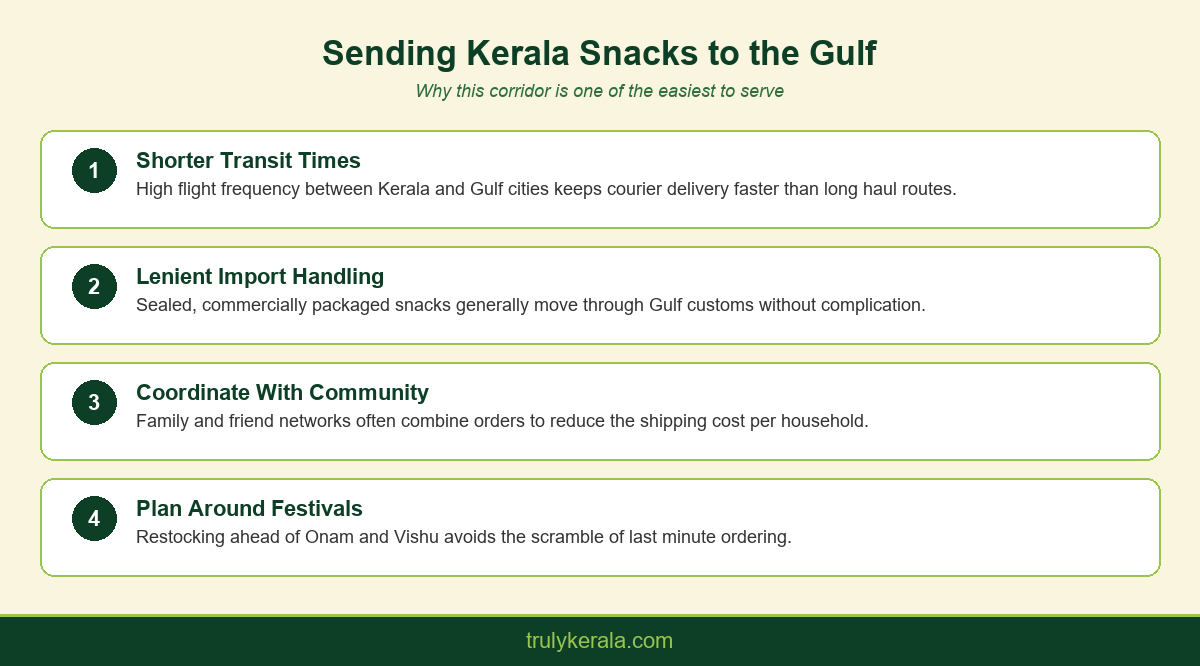
Compared to long haul destinations, sending snacks to the Gulf is relatively straightforward. Flight frequency between Kerala and cities like Dubai, Abu Dhabi and Sharjah is high, courier transit times are shorter, and the region's food import rules are generally accommodating toward sealed, commercially packaged snacks. This is one reason the Kerala to Gulf corridor sees so much personal luggage traffic in packaged food, alongside formal courier shipments.
For travellers planning to carry snacks themselves on an upcoming visit, the airport and customs considerations are covered in our guide to carrying or shipping banana chips abroad. For those who would rather have a supply shipped directly without waiting for a trip home, our international shipping guide for NRIs walks through courier options and realistic timelines for the region.
It is also common for Gulf based Malayalis to place orders on behalf of colleagues from other parts of India who have developed a taste for Kerala snacks after years of working alongside a Malayali community. This cross cultural spread is one of the quieter ways authentic regional food ends up travelling even further than the diaspora it was originally made for.
Building a Gulf Pantry That Actually Feels Like Home
A well stocked Gulf pantry usually includes banana chips fried in coconut oil for everyday snacking, whole green cardamom for chai and cooking, and a rotation that gets restocked before a big festival rather than after supplies run out. Since large numbers of Indians live in the UAE and neighbouring Gulf states, community groups and family networks often coordinate bulk orders together to reduce shipping cost per household.
Festivals are a particularly good trigger point for restocking. Onam and Vishu celebrations away from Kerala rely heavily on the same snacks and hampers families would use back home, and planning around the calendar rather than reacting last minute makes a noticeable difference. Our piece on celebrating Onam and Vishu as part of the diaspora has specific timing suggestions for exactly this.
It also helps to think about a Gulf pantry in terms of routine rather than emergency restocking. Households that run out of chips or cardamom tend to make do with whatever is on the nearest shelf, which is exactly the compromise this whole article is describing. Setting a simple habit, such as reordering every couple of months regardless of how much is left, avoids that gap entirely and keeps the pantry consistently stocked with the real thing rather than a stopgap substitute bought in a hurry.
A Note for Second Generation Gulf Malayalis
Children who grow up in the Gulf rather than Kerala itself often form their entire relationship with these snacks through what their parents choose to keep in the pantry. For this generation, an authentic banana chip is not nostalgia in the same way it is for someone who grew up in Kerala. It is simply their baseline definition of what the snack should taste like, which puts even more pressure on households to get the sourcing right the first time rather than settling for whatever is convenient.
This generational angle is quietly shaping demand across the Gulf. Parents who care about passing on an accurate sense of Kerala food culture are often the most consistent, repeat buyers of authentic products, since they are stocking a pantry for their children's memories as much as their own.
Conclusion
Gulf Malayalis have built one of the most food conscious diaspora communities in the world, and that comes with high expectations for what counts as an authentic Kerala snack. Coconut oil, the right plantain variety and proper sealing are not optional details for this audience, they are the entire point. Whether you are ordering for yourself in Dubai or sending a package to family across the Gulf, our complete NRI diaspora guide ties together shipping, customs and gifting into one resource, and TrulyKerala's cardamom and banana chips are ready whenever you are.
Frequently Asked Questions
Why do Gulf Malayalis prefer authentic Kerala chips over local options?

Are Kerala snacks easy to find in Dubai grocery stores?
How long does it take to get chips shipped to the UAE from Kerala?
What is the best way to stock a Gulf pantry with Kerala snacks?
Do customs rules differ much across Gulf countries for food items?
Why is coconut oil such a big deal for Kerala banana chips?
Can I order Kerala cardamom for daily chai in the Gulf?