2027 Regional Snack Exports: Why Kerala's Traditional Foods Are Going Global via D2C

India's food exports are on a steady climb, and APEDA's export overview, summarised by IBEF, puts agricultural and allied exports at US$ 51.91 billion in FY25. Traditional Kerala snacks are riding part of that wave. More families in Dubai, Toronto and Bengaluru now search for Kerala banana chips online instead of waiting for a relative's suitcase. If you are a buyer, a gifting company or a retailer weighing this category, talk to the TrulyKerala team about what you need. This guide explains why regional snacks are going global through direct to consumer (D2C) channels, what the data says, and what the 2027 outlook looks like.
Key takeaways
- Export and online retail data from 2025 and 2026 point to rising demand for authentic regional food, and buying Kerala banana chips online is one clear example.
- D2C lets a Kerala brand sell straight to households and gifting buyers in India and abroad, with full control over freshness, oil quality and packaging.
- Festive gifting, such as a Diwali gift hamper of Kerala snacks bought online, is a practical entry point for first time buyers.
Why Kerala's Traditional Snacks Are Finding Global Buyers
Kerala's snacks travel well because they are simple, shelf stable and tied to strong memories. A crisp banana chip fried in coconut oil needs no explanation to anyone who grew up with Onam sadya.
Bananas are a global staple, yet the export trade is narrow. The FAO banana market overview notes that world banana trade sits around 20 million tonnes a year, and that India and China are the largest producers for domestic consumption. In other words, India grows bananas mainly for its own table. That is exactly why processed, value added forms such as chips matter. They turn a local crop into a product that can cross borders.
Kerala chips are made from Nendran bananas, a variety prized for its firm texture. TrulyKerala sources Nendran from its own farms and follows a traditional four ingredient process. For buyers abroad, that traceability is often the deciding factor. People who buy Kerala banana chips online want to know where the fruit was grown and which oil was used.
There is also a cultural pull. For many Malayalis abroad, a packet of chips is a link to home festivals, school tiffin boxes and family gatherings. For new buyers, it is a crunchy, naturally gluten free snack with a story behind it. Both groups reward brands that keep the recipe honest instead of chasing mass market shortcuts.
What the Numbers Say About India's Food Export Momentum
The data from government and industry sources shows that the base for regional food exports is growing, not shrinking.
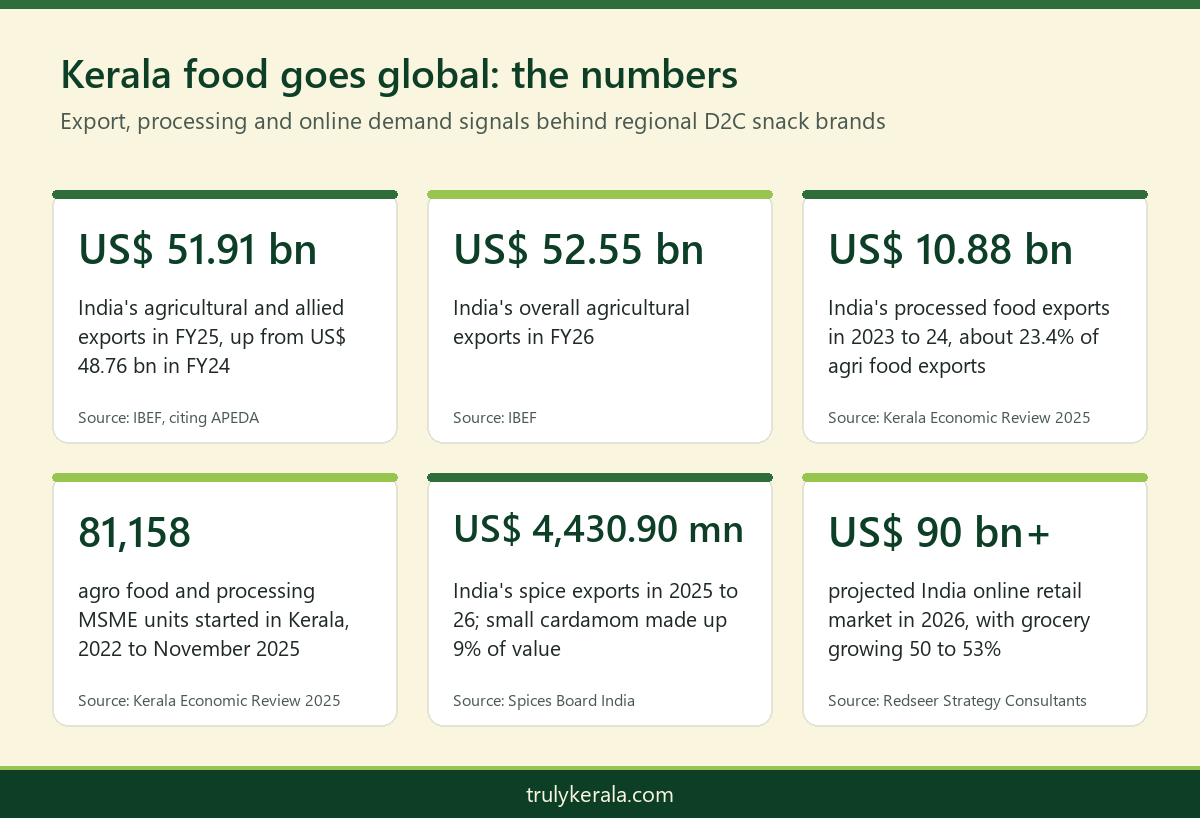
IBEF reports that India's overall agricultural exports reached US$ 52.55 billion in FY26, up from the FY25 level. Processing is a big part of the story. The Kerala Economic Review 2025 chapter on food processing records that India's processed food exports were US$ 10.88 billion in 2023 to 24, about 23.4 per cent of agri food exports. The same review shows that about 81,158 MSME units in agro food, beverage and processing subsectors were started in Kerala between 2022 and November 2025 under the Year of Enterprises programme. Food processing units made up 48.22 per cent of all manufacturing units started in that period.
Spices tell a similar story. The Spices Board export review puts India's spice exports at US$ 4,430.90 million in 2025 to 26, with small cardamom contributing 9 per cent of value. Kerala is India's cardamom heartland, and TrulyKerala also sells whole green cardamom alongside its chips.
How D2C Changes the Route From Kerala Kitchen to World Table
D2C removes layers between the maker and the buyer, which protects freshness and gives small Kerala brands a direct voice.
Traditionally, a Kerala snack reached a shelf in Dubai after passing through a manufacturer, an exporter, an importer and a retailer. Each step added time, and banana chips lose crunch when they sit too long. A D2C brand can sell from its own website, fry in small batches and dispatch soon after packing.
Online retail is growing fast enough to support this model. Redseer's India online retail 2026 report projects the market to cross US$ 90 billion in 2026, with grocery growing 50 to 53 per cent and set to overtake mobiles as the second largest online category. Shoppers who search for a traditional Kerala snacks online store near me increasingly expect home delivery rather than a trip to a speciality shop.
D2C also changes what buyers can check before they order. A product page can show the banana variety, the oil, the pack size and the flavour list in one place. TrulyKerala, for example, sells banana chips in 125g, 150g and 500g packs, so a buyer can start small and scale up. That transparency builds the trust that a crowded supermarket shelf rarely offers. It also gives the brand direct feedback, so it can learn which flavours and pack sizes repeat buyers prefer.
For businesses, D2C and B2B work together. TrulyKerala offers bulk supply, white label and export partnerships, with export ready packaging, international compliance support and logistics coordination. Retailers abroad can therefore stock the same product that Indian households order direct.
Where the Demand Is: The Gulf, the US and the Diaspora
India's agricultural export map shows exactly where Kerala snacks have natural buyers.
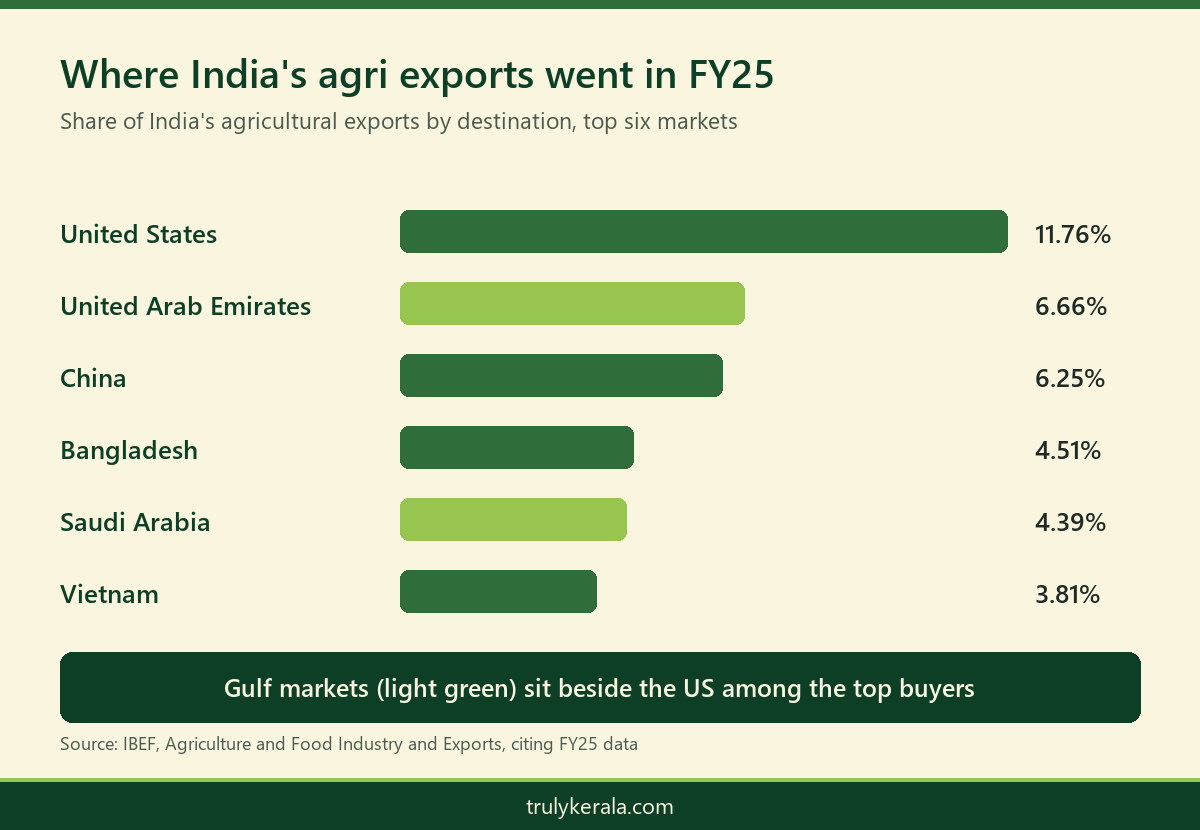
According to IBEF, the United States took 11.76 per cent of India's agricultural exports in FY25, followed by the United Arab Emirates at 6.66 per cent and China at 6.25 per cent. Saudi Arabia ranked fifth at 4.39 per cent. The Gulf markets matter especially for Kerala, given the large Malayali community in the region. Many Malayali families in the UAE and Saudi Arabia already know Nendran chips and sharkara varatti by taste.
Diaspora buyers often become brand ambassadors. They share snacks with colleagues and neighbours, which creates demand beyond the community. This is part of the global appeal of Kerala's chips. TrulyKerala's range already spans flavours for both Indian and international palates, from classic salted and black pepper to peri peri and ripe banana sweet chips.
The US share matters too. It is the single largest destination for Indian agricultural products, and it is home to a sizeable Indian community. For a D2C brand, these numbers help decide where to focus partnerships first. Starting with markets that already import Indian food lowers risk, because importers there already understand the paperwork and the products.
Festive Gifting as the Launch Pad for 2027
Festivals give regional snack brands a reason to be discovered, and Diwali is the biggest gifting moment of the year.
Diwali falls in early November this year, which makes October the planning month for hampers. A Diwali gift hamper of Kerala snacks bought online feels personal and different from a generic sweet box. Pairing banana chips with cardamom gives the recipient something savoury and something aromatic in one pack. Ordering Kerala banana chips online a few weeks early also avoids the last minute courier rush. Companies can explore corporate gift hampers for clients and teams.
Looking ahead to 2027, the outlook is encouraging rather than certain. Export figures have held steady, online grocery is expanding quickly and Kerala keeps adding food processing enterprises. If those trends continue, more first time festive buyers are likely to turn into repeat customers who order Kerala snacks all year. Brands that prove authenticity, such as pure coconut oil, farm sourcing and no artificial additives, are best placed to keep that loyalty.
Conclusion
Kerala's traditional foods are going global because the data, the channels and the demand now line up. India's agricultural and processed food exports remain strong, Kerala is adding food processing enterprises at scale, and online retail is making it easy for anyone to order Kerala banana chips online. D2C lets a farm based brand like TrulyKerala reach households and gifting buyers directly, while partnerships open doors for retailers abroad. Whether you are planning Diwali hampers or a 2027 export range, explore our banana chips range and reach out to place your order.
Frequently Asked Questions
Where can I buy Kerala banana chips online?

Why are Kerala's traditional snacks becoming popular abroad?
What does D2C mean for a regional food brand?
Are Kerala banana chips a good Diwali gift?
How big are India's agricultural exports right now?
Which countries buy the most Indian agricultural products?
Does TrulyKerala supply businesses and exporters?
What makes authentic Kerala banana chips different?
What flavours of banana chips are available?
What is the 2027 outlook for Kerala snack exports?