Cardamom in Global Cuisine: From Scandinavian Baking to Middle Eastern Coffee

Long before it became a pantry staple across continents, cardamom in world cuisine traveled from Kerala's misty hills to kitchens thousands of miles away. Nordic bakers fold it into spiced buns, Middle Eastern hosts brew it into ceremonial coffee, and German kitchens tuck it into Christmas gingerbread dough. This global reach did not happen by accident. The same bold, eucalyptus sweet aroma that Kerala farmers have cultivated for generations travels well and holds its character in both sugar and spice. Building on TrulyKerala's overview of modern and global uses for cardamom, this guide tours three standout international traditions and shows where an authentic, farm sourced pod fits in.
Key Takeaways
- Scandinavian bakers have used cardamom in sweet buns and pastries for generations, making it a defining flavor of Nordic baking.
- Middle Eastern coffee culture treats cardamom as an essential ingredient in qahwa, a ceremonial coffee central to hospitality customs.
- International cardamom recipes, from German gingerbread to Turkish coffee, rely on the same whole pod quality that TrulyKerala sources direct from Kerala farms.
A Spice That Traveled Far Beyond India
Cardamom's journey outside India stretches back centuries, carried along ancient spice routes that connected Kerala's coast to Arabia, the Mediterranean, and eventually Northern Europe. Traders exchanged the aromatic pods for silk, textiles, and other goods, and each region that received cardamom adapted it to local tastes. Scandinavian bakers embraced it in sweet doughs. Middle Eastern communities folded it into coffee rituals. German and Central European kitchens paired it with warming winter spices. Understanding cardamom's long documented history helps explain why the spice still feels at home in so many unrelated cuisines today.
What ties these traditions together is not geography but chemistry. Cardamom's essential oils, cineole and terpinyl acetate among them, hold up under heat and blend cleanly with both sugar and bitterness. That versatility is exactly why the spice never stayed confined to one region's pantry, and why international cardamom recipes keep multiplying decades after the original spice routes closed. European traders, including Dutch and Portuguese merchants active along the Malabar coast, carried cardamom north alongside pepper and cinnamon, and it settled most firmly into the pantries of countries with strong winter baking traditions. That pattern still holds today: the coldest climates often show the deepest cardamom habits, since a warming, aromatic spice pairs naturally with long indoor baking seasons.
Scandinavian Baking Traditions: Kardemummabullar and Beyond
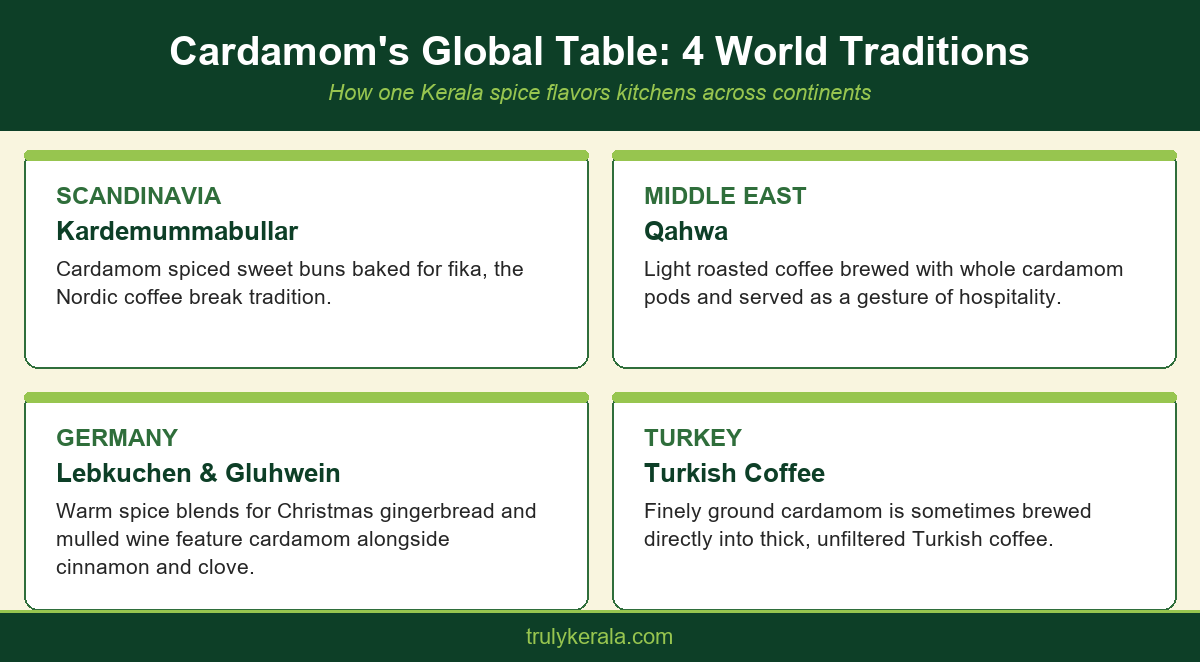
Sweden, Norway, and Finland treat cardamom as a baking essential rather than an occasional flavoring. Kardemummabullar, cardamom scented sweet buns rolled with butter and sugar, appear at the fika break that punctuates the Nordic workday. Bakers crush whole pods themselves rather than reaching for ready ground powder, since freshly cracked seeds deliver a sharper, more citrus forward aroma. The same spice shows up in Finnish pulla bread and Danish holiday pastries, often alongside cinnamon but never overshadowed by it.
TrulyKerala's dedicated post on cardamom baked into Scandinavian sweet buns and other treats walks through the techniques that make Nordic doughs work, including how pod freshness changes the final aroma. Because whole pods retain their oils far longer than ground spice, home bakers recreating these scandinavian cardamom buns outside Scandinavia get the best results starting from whole green cardamom rather than a jar of ready ground powder.
Norway has its own version, cardemommeboller, often shaped as knots or twists rather than the coiled Swedish bun, while Finnish bakers work cardamom into pulla loaves alongside pearl sugar and almonds for holidays and family gatherings. In every case, the spice is measured generously rather than sparingly. Nordic recipes commonly call for a full teaspoon or more of freshly crushed seeds per batch of dough, a quantity that would overwhelm a mild dessert but reads as balanced once baked into a rich, buttery bun.
Middle Eastern Coffee Culture: The Ritual of Qahwa
Across the Gulf, Levant, and parts of North Africa, cardamom is inseparable from coffee. Qahwa, a light roasted coffee brewed with crushed cardamom pods, is served in small handleless cups as a gesture of welcome, often before any conversation begins. Hosts sometimes add saffron or rosewater, but cardamom remains the constant. The spice cuts through the coffee's bitterness and leaves a lingering, almost floral finish that has become the signature of Gulf hospitality.
Readers curious about recreating that experience at home, or building modern drinks beyond traditional qahwa, can explore TrulyKerala's guide to cardamom coffee and mocktail recipes. The same qualities that make Kerala cardamom suited to qahwa, a strong aromatic punch from a whole, unbroken pod, are what Middle Eastern coffee roasters have prized for generations, as documented in accounts of traditional Arabic coffee customs.
The brewing method itself reflects the ritual's importance. Coffee is simmered slowly in a long necked dallah pot, often with the cardamom pods left whole so guests can see them settle at the bottom of the cup. Refilling a guest's cup is a mark of generosity, and a guest who has had enough signals this by gently shaking the empty cup rather than declining outright. None of this etiquette would carry the same weight without the cardamom, which gives Gulf coffee its instantly recognizable scent before a single sip is taken.
Other Global Touchpoints: German Spice Blends and Turkish Coffee
Cardamom's global reach extends well past Scandinavia and the Gulf. German and Austrian bakers add it to lebkuchen and other Christmas spice blends, where it rounds out cinnamon, clove, and nutmeg in gingerbread dough and mulled wine. In Turkey, finely ground cardamom is sometimes brewed directly into thick, unfiltered coffee for a warmer, more fragrant cup than the plain version. Even parts of the Baltic region use cardamom in holiday breads, showing how thoroughly the spice has embedded itself in winter baking across the northern hemisphere.
For cooks new to working with whole pods rather than powder, TrulyKerala's beginner friendly spice guide explains how to crack, grind, and store cardamom for the best results, whichever international recipe you are following.
Turkish coffee drinkers sometimes read the dried grounds left in the cup after drinking, a custom known as tasseography, and a cup brewed with cardamom is considered a small gesture of extra care toward a guest. Christmas markets across Germany and Austria sell cardamom scented gluhwein and gingerbread by the thousands each winter, proof that the spice's popularity in Central Europe is no niche trend but a seasonal expectation shoppers look forward to every year.
Why Global Cooks Choose Kerala's Whole Green Cardamom
Every tradition covered here, from Nordic buns to Gulf coffee, depends on one thing: pod quality. Cardamom loses its aromatic oils quickly once it is cracked or ground, so bakers and coffee roasters around the world look for whole, unbroken pods sourced as close to harvest as possible. TrulyKerala grows and sources its whole green cardamom directly from farms in Kerala's Western Ghats, the same region that has supplied international spice traders for centuries.
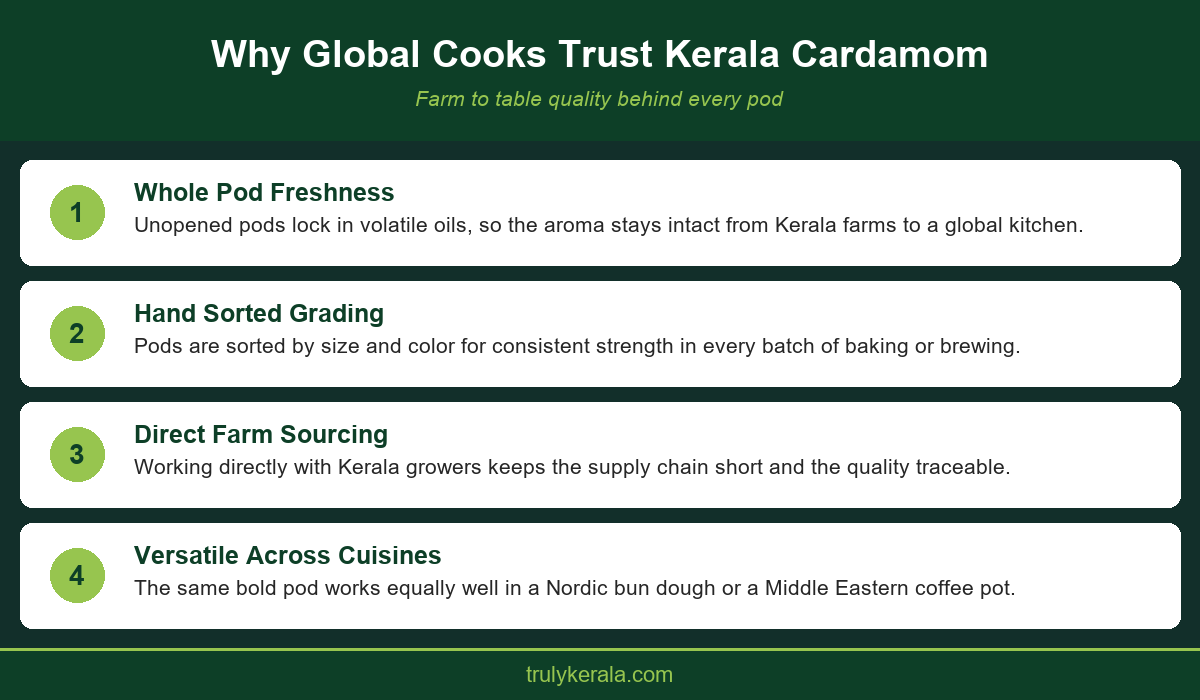
Whether a recipe calls for crushing a few pods into hot milk for a Scandinavian bun dough or brewing them whole in a coffee pot for qahwa, the starting point is the same: a fresh, high quality pod that has not sat ground on a shelf for months. Kerala's warm, humid growing conditions along the Western Ghats produce pods with a naturally high oil content, which is one reason the region has remained a preferred source for bakeries and coffee roasters exporting far beyond South Asia.
Conclusion
From Scandinavian fika tables to Gulf coffee ceremonies, cardamom in world cuisine tells one consistent story: quality pods travel well and reward bakers, brewers, and home cooks who choose whole over ground. Scandinavian buns, Middle Eastern qahwa, German gingerbread, and Turkish coffee all lean on the same aromatic strength that Kerala farms have delivered for generations. If your own kitchen leans toward the traditional Indian side of cardamom cooking instead, see TrulyKerala's traditional Indian cardamom recipes for inspiration. Otherwise, shop TrulyKerala's full range of spices and snacks and bring an authentic, farm sourced pod to your own international recipe.
Frequently Asked Questions
What is cardamom in world cuisine used for outside India?

Why do Scandinavian bakers use so much cardamom?
What is qahwa and why does it contain cardamom?
Is whole cardamom better than ground cardamom for these recipes?
Do Middle Eastern and Scandinavian cardamom uses overlap?
What other countries use cardamom in cooking?
How much cardamom is used in a typical international recipe?
Can I substitute ground cardamom in Scandinavian or Middle Eastern recipes?
Where does the cardamom used in global recipes typically come from?
What is whole green cardamom used for beyond baking and coffee?